Top Primary School Students Awarded in HRA’s Literary Competition “Togetherness in Diversity” – Children’s Writing for Adults, Too!
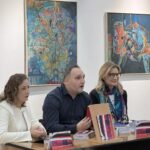
There is hope for a better future if we listen to our children! Children respond positively to a diverse society. Many thoughtful ideas expressed by Montenegrin primary school students could be heard at the award ceremony for the best entries submitted by pupils from the 6th to the 9th grade in the literary competition organized by the NGO Human Rights Action (HRA) on the topic “What Does Togetherness in Diversity Mean to Me?”, held on 26 March at the Europe House in Podgorica.
A total of 236 children’s entries were submitted from 20 towns and cities across the country, and each child, in their own way, conveyed the message that differences should be celebrated and that the dignity of every human being should be respected.
Particularly outstanding were Zilha Dizdarević from Bijelo Polje and Ksenija Janković from Podgorica, who shared the first prize.
Zilha wrote from the perspective of a child about the relationship between parents burdened by religious divisions and about their love, “which does not know how to be happy, but knows how not to give up.” Ksenija wrote about visiting a city where people of all kinds are accepted and where she learned to be herself. She sent the message that everyone should fight for the right to be different, both for themselves and for others.
Sofija wrote about her family, made up of a mother from the Philippines and a Montenegrin father, about a grandmother who is her daughter-in-law’s best friend, but also about a patriarchal society in which some people still condemn her parents’ marriage. Martin described how, through sport, he learned that togetherness “begins when we accept that we are different, yet still ready to stand by one another,” and he recounted his friendship with a boy from an opposing team from another country and the boy’s parents, who cheered him on during a match.
Petra described how a school trip to Cetinje became a “life lesson” for her because it helped her become friends with a Roma girl. She said that togetherness in diversity means “not seeking identical lives, but equal dignity.” Sara wrote about her aunt Ana, who was born with a disability that did not prevent her from being brave, determined, and full of a zest for life that attracts everyone around her. Blanka approached the topic philosophically and reminded us that we are all born equal, but then “the training for divisions begins.” She concluded that togetherness should not be only a goal, but also “the only possible path for humankind.”
The award for the best poetic entry was presented to Dalibor Tošić from Nikšić. His verses — “I do not always run like the others, but I rejoice in every day. Togetherness is when you accept me and see a friend in me — not a flaw” — drew strong applause from everyone present.
A total of 19 entries were shortlisted, and their authors received diplomas.
All children who took part in the competition will receive as a gift the book “The Summer I Learned to Fly” by Jasminka Petrović, which in a humorous and child-friendly way speaks about the restoration of family and friendship ties among people in countries divided by war.
The best entries, which can be read on the HRA website, were selected by the members of the jury: Petar Pejaković, director of over 50 theatre performances for children, and Tea Gorjanc-Prelević, Executive Director of Human Rights Action, with the assistance of Miroslav Minić, a literature teacher at the grammar school in Danilovgrad, as well as Martina Markolović, social worker, Elizabeta Mrnjačević, political scientist, and Bojana Malović and Amra Bajrović, lawyers at Human Rights Action.
In his opening remarks, Minić said that he was fascinated by the courage the young writers had shown in their entries. “This is proof that it is wonderful to live in this country with you… When I read your work, I realized that you are amazing and that this country has a good future. Like adults, you showed that you are tolerant and humane, that you feel deeply and want to change both yourselves and the world you live in for the better,” said Minić.
“Remember that you have strength and that you are capable of teaching adults how to behave, how to socialize, and how to respect people who are different,” said Tea Gorjanc-Prelević, HRA’s Executive Director.
Martina Markolović, HRA coordinator and a member of the jury, emphasized that she had greatly enjoyed reading the entries. “I learned a great deal from you. I thought that was a worn-out phrase, but you truly are teaching us that the world can be better. Thanks to you, we have new hope. I hope that my child will follow in your footsteps as well,” Markolović said.
Human Rights Action will mark the 20th anniversary of the restoration of Montenegro’s independence by publishing, every day until 21 May, the main messages expressed by children in the entries submitted to this competition.
“For us, all of you are activists, and we hope that this award will encourage you to stand up in practice for the rights of others as well. To stand up so that in your school, in your town, and in our country, no one suffers because they are different, because they belong to another ethnic, religious, or national group, or because they are different in any other way — because of their sexual orientation, skin colour, or interests. We must respect everyone and everyone’s dignity,” Gorjanc-Prelević told the students, their teachers, and parents who were present.
A similar message was conveyed in her work by first-prize winner Ksenija Janković, a 9th-grade student: “With your voice, break down all the walls between us.”
May it be so!
The literary competition on the topic “What Does Togetherness in Diversity Mean to Me?” was organized as part of the project “Life in Togetherness: Young People’s Views on Diversity and Belonging,” which Human Rights Action is implementing with the financial support of the European Union and within the framework of the Reporting Diversity Network programme. The content of this publication is the sole responsibility of Human Rights Action and does not necessarily reflect the views of the European Union or the Reporting Diversity Network programme.




 English