INTERNATIONAL DAY FOR THE RIGHT TO THE TRUTH CONCERNING GROSS HUMAN RIGHTS VIOLATIONS AND FOR THE DIGNITY OF VICTIMS – Justice for Victims Is Key to Democracy
INTERNATIONAL DAY FOR THE RIGHT TO THE TRUTH CONCERNING GROSS HUMAN RIGHTS VIOLATIONS AND FOR THE DIGNITY OF VICTIMS – Justice for Victims Is Key to Democracy
Today, 24 March, we mark the International Day for the Right to the Truth concerning Gross Human Rights Violations and for the Dignity of Victims, established by the UN General Assembly in 2010 in memory of Archbishop Óscar Arnulfo Romero — who was murdered in 1980 while celebrating Mass, after publicly condemning mass human rights violations, killings, and torture during the Salvadoran civil war. Even decades after his murder, no one has been held accountable. This pattern of impunity is, unfortunately, a global problem.
Montenegro: Failure to Confront the Past Blocks Democratic Progress
In Montenegro, the gravest human rights violations — war crimes — still have not been adequately prosecuted, and victims have not been provided with adequate legal or moral redress. Only one trial is currently underway, against Zoran Gašović for war crimes against civilians in Hadžići, while there are still no new investigations or indictments related to the Dubrovnik battlefield and old cases that were inadequately prosecuted (Deportation, Bukovica, Kaluđerski Laz, Morinj).
Institutions must urgently take concrete steps:
prosecute war crimes committed on the territory of Montenegro or in its name during the 1990s, and help the families of the missing learn where their relatives’ remains are located;
adopt a law on the rehabilitation and compensation of victims of political persecution — especially the 3,390 prisoners of Goli Otok, who suffered because of the conflict with the Informbiro, and who to this day have not been legally rehabilitated;
open the archives of the National Security Agency (ANB). States in the region have already opened the archives of their security services; Montenegro is the exception.
Global Context: Violence and Impunity Are Increasing
More than one hundred armed conflicts are currently ongoing around the world. Civilians are paying the highest price.
In Ukraine, four years of the Russian invasion have cost at least 15,172 lives, including 766 children. Another 41,378 people have been injured, including 2,540 children. Millions have been displaced. The International Criminal Court (ICC) has charged six high-ranking Russian officials with war crimes, including Russian President Vladimir Putin, for whom it has also issued an arrest warrant. Russia does not recognize the ICC.
In the Middle East, after the Hamas attack on Israel on 7 October 2023, in which around 1,200 people were killed, Israel’s response through its attack on Gaza turned into a humanitarian catastrophe: more than 72,000 Palestinians have been killed, including more than 600 even after the announcement of a ceasefire. Hunger and the lack of medical assistance continue to claim lives every day. The ICC has charged the Prime Minister and former Defence Minister of Israel with war crimes and issued arrest warrants for them. The accused Hamas leaders on the Palestinian side were killed in Israeli attacks. Israel does not recognize the ICC.
In the attacks by Israel and the United States on Iran, carried out in violation of the UN Charter on 28 February 2026, at least 1,500 people have been killed so far and more than 18,500 have been wounded. In Iran’s response, through attacks on targets in Israel and mainly military US bases in the Middle East, around 50 people were killed and nearly 4,000 were wounded. Particularly alarming is the targeting of civilian sites by the US and Israel, such as the attack on an elementary school in Minab, in which at least 200 women and 168 children were killed.
Iran does not recognize the ICC, nor do the US or Israel, and that is why the Court is not dealing with crimes committed in this war.
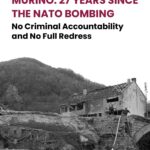
Today also marks the 27th anniversary of the NATO bombing of the FRY. Civilian suffering and the so-called collateral damage caused by that bombing (such as the attack on the Radio Television of Belgrade building, the centre of Niš, Aleksinac, and Murino in Montenegro) have largely not been prosecuted. There is no official list of victims, but one was compiled by the Humanitarian Law Center, and its findings have not been disputed.
The Right to the Truth Is Not a Privilege — It Is an Obligation
The 2005 UN Resolution defines the right to the truth as a fundamental right of victims and their families: the right to know the fate of the missing, the causes of crimes, and the identity of the perpetrators.
This right is not only a moral category — it is also an instrument of prevention. Societies that fail to prosecute past atrocities are condemned to repeat them.
Human Rights Action (HRA) pays tribute to all those who have made personal sacrifices in the struggle for justice for victims of human rights violations, and reiterates its call to the institutions of Montenegro: confront the past for the sake of a safe future that we owe to our children.



 English