High School Students Have Limited Knowledge of the 1990s Wars – Talking About the Past Is Essential
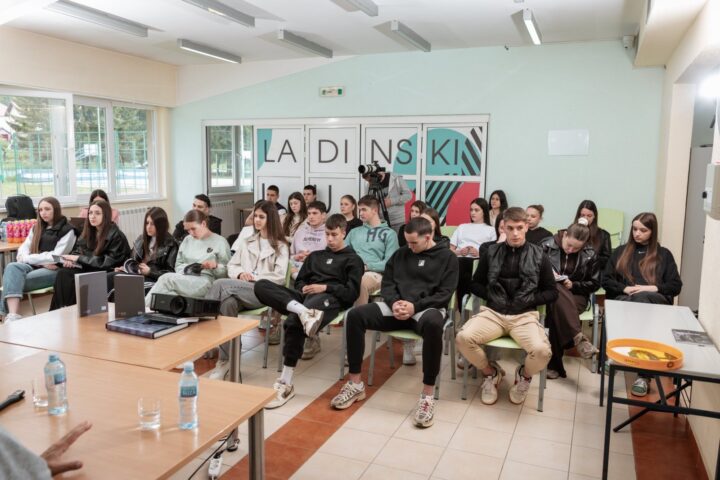
The breakup of the Socialist Federal Republic of Yugoslavia (SFRY) during the 1990s did not have to be bloody and it is of essential importance that we learn in time how to resolve conflicts without violence and to learn from mistakes, it was said during the third “Coffee with Remembrance” meeting, organized in May in Mojkovac by the NGO Human Rights Action.
Students of the “Vuksan Đukić” Secondary Mixed School, who attended the event, admitted that they knew little about that turbulent period. They were not familiar with the 1991 attack on Dubrovnik or with the wars of the 1990s in the territory of the former Yugoslavia. They also said they did not know how the breakup of that country came about.
They said that in history classes they cover the events of the 1990s only superficially, or do not learn about them at all. Some students said they get information through social media, such as TikTok, and that there they had “learned” to doubt that genocide was committed in Srebrenica.
Historian Miloš Vukanović explained that it is important to understand, on the basis of historical facts, how and why citizens who had lived in the spirit of brotherhood and unity suddenly went to war against their closest neighbors.
This is what Montenegrin soldiers did in 1991 when, as members of the Yugoslav People’s Army (JNA), they took part in the attack on Dubrovnik.
“I was born in Yugoslavia. I was young when it broke apart, but I grew up hearing stories that it had been a good time and an orderly society. Then I learned that in the 1990s that country did not break apart peacefully. While Europe was uniting, we were dividing, splitting apart, clashing, and regressing, only to find ourselves ten years later lagging behind much of Europe”, Vukanović said.
Who Is Responsible for the Conflicts?
During the discussion, the students were also given further explanation of the historical context of the breakup of the SFRY. It was emphasized that three former Yugoslav republics — Slovenia, Croatia, and Macedonia — held independence referendums in accordance with the constitutional framework in force at the time: Slovenia first, on December 23, 1990; Croatia in May 1991; and Macedonia in early September 1991. In those referendums, the majority of citizens voted for independence, after which these republics declared independence.
It was also explained that the war in Slovenia was fought because the Yugoslav People’s Army (JNA) wanted to prevent that republic’s independence. This first war in the territory of the former Yugoslavia lasted ten days in June 1991. It ended with the withdrawal of the JNA from that republic before the beginning of the war in Croatia, which escalated over the summer while the international community was trying to find a peaceful model for separation.
The students were told that in Croatia, alongside the process of gaining independence, a portion of Croatian Serbs, with the support of the authorities in Belgrade, launched a rebellion against the Croatian republican authorities, which in 1991 grew into an open armed conflict. In that conflict, the JNA sided with the rebel Serbs and became involved in military operations on the territory of Croatia.
Montenegro also took part in this through the mobilization of its citizens. During the summer of 1991, the mobilization of the JNA reserve forces was carried out in Montenegro, accompanied by strong war propaganda in the media.
The JNA attack on Konavle, the Dubrovnik region and Dubrovnik began on October 1, 1991, from the territory of Montenegro and Bosnia and Herzegovina. The aim of the JNA, which was commanded from Belgrade, was to prevent Croatia’s independence by occupying its territory. Montenegro supported that policy and the mobilization of its citizens into the ranks of the JNA for the attack on Croatian territory. More than 7,000 mobilized citizens of Montenegro took part in that military operation.
The first association Mojkovac high school students have with war is victims.
Having learned how many victims there were on the Dubrovnik battlefield alone, the students were interested in the responsibility of the actors of that time for the conflicts.
“What is being suppressed in Montenegro today – the responsibility of the political or military leadership at the time?” the students asked.
Vukanović spoke about the responsibility of politicians.
“Why is political responsibility important to me? So that I know who sent us there and why, but even more importantly, which ideas sent us to war. We need to analyze who gathered those young men and with what goals they sent them, so that this never happens to us again”, the historian said.
In addition to the responsibility of the system, the students were also interested in the role of citizens during the 1990s.
“Where does the responsibility of those people begin – in the silence of individuals, or in the support that ordinary people gave to the war?” one student asked.
Both Miloš Vukanović and Ervina Dabižinović, psychologist and coordinator of the Centre for Women’s and Peace Education – ANIMA, pointed to responsibility for remaining silent.
“We are responsible because we did not do enough to prevent it, and that responsibility applies to a larger number of people”, she said.
“Some people resist, some only observe, and many do nothing out of fear for themselves and their families. That is precisely the question of responsibility”, Vukanović said.
However, the fact that there were people in Montenegro who raised their voices against the war was recalled by the executive director of the NGO Human Rights Action, Gorjanc-Prelević.
She pointed to the role of Montenegro’s anti-war movement.
“There were several thousand people who were against the war and tried to prevent it. So, we were not all mistaken. At anti-war rallies in Cetinje, people sang: ‘From Lovćen, the fairy cries out: forgive us, Dubrovnik.’ It was the Liberal Alliance, which advocated for a sovereign and independent Montenegro, the kind we have today… But they were a very small minority, because there were no conditions for their voice to be heard,” Gorjanc-Prelević added, telling the students to pay attention and listen to everyone.
“I advise you to always listen to the voice that is different from the majority in your surroundings. History teaches us that huge groups of people have been mistaken and made errors because they did not listen to the minority,” the HRA director said.
“For a long time, there was a perception that we all went to Dubrovnik and that everyone supported the war, but today we know that this was not true,” Vukanović concluded.
The “Frog in Boiling Water” Syndrome
“Many times in history, people have gone to war because of false information, and it was precisely such information that led to the attack on Dubrovnik, which was a major historical mistake,” said Tea Gorjanc-Prelević, executive director of the NGO Human Rights Action.
“Propaganda serves to heat up emotions. To create fear, to create hatred that can easily lead people into war… Warmongering rhetoric claimed that Croats were preparing to attack us, while they were derogatorily called Ustaše and Zengas, that is, Croatian fascists from the Second World War. The aim was to revive fear of the villains from the Second World War and turn it into hatred that would justify the attack that was to follow,” she said.
Historian Miloš Vukanović recalled that the Montenegrin public was being “poisoned,” slowly drawn into the conflict, and that everything culminated in the story of “Ustaše marching on Montenegro.”
“The unified media campaign and manipulation were so strong. For six months, people listened to stories about those who, until recently, had been our brothers, but were now suddenly Ustaše.”
In the end, the people experienced the fate of the “frog in boiling water,” says Ervina Dabižinović.
“When you put a frog in hot water, it jumps out, but when you put a frog in cold water and heat it slowly, it boils without even realizing it has been boiled. It dies without even knowing that it is happening… There was a narrative that had been built up over a long period,” Dabižinović said.
“The attack did not happen suddenly; rather, the frog had been boiling for a long time. The whole society was being boiled in schools, at universities, in the streets, in barracks, in cafés. Society was being boiled before the march on Dubrovnik began.”
“We are here to talk with you so that you can try to notice when someone is boiling your generation,” Vukanović told the students.
One person who admits that he succumbed to the propaganda of the 1990s and went to war because of it is lawyer Budislav Minić. He admits that he believed the “news” being spread, such as the claim that Croats were “making necklaces out of the little fingers of Serbian children”, and that only after arriving at the Dubrovnik battlefield did he realize what was happening there.
“There I saw the suffering of young parents and children. I saw fear of savagery, of the looting by the JNA, of everything that could be carried away being taken. That is unforgettable,” Minić said.
“The only thing that gives me peace is the fact that I was never in a position to fire a bullet at anyone. During that time, my mother — and I am an only child — suffered every evening because on TVCG news she heard that Croatian artillery was shelling us, even though that was not true,” the war veteran said.
Minić also shared the experience of meeting a family from the hinterland of Dubrovnik, which, he says, marked his life. It was a young seafarer, his wife, and their two children, with whom he developed a close relationship during his time on the battlefield.
“The wife was a passionate smoker and had not had cigarettes for months. She would roll grass and leaves in order to smoke. I regularly took cigarettes from my rations and brought them to that woman,” Minić recalled.
Before he left the battlefield, the host, he said, asked his wife to bring out a bottle of whisky they had been saving “for the day they survived the war.” “He said he wanted to drink it with the man who had helped them at that time. We toasted in tears,” Minić said.
Dabižinović said that precisely such moments show how, despite wartime circumstances, people can recognize one another through empathy and another person’s suffering.
“The perpetrator and the victim can meet at one point — when we see the human being across from us and believe in their suffering,” she said.
Facing the past and learning about it is essential
The main message conveyed to high school students in Mojkovac during Coffee with Memory was that the war did not have to happen and could have been avoided.
“The essence is to learn in time that conflicts should be resolved without confrontation, without violence… The breakup of Yugoslavia did not have to be bloody. More than 110,000 people, including tens of thousands of young people, did not have to lose their lives,” said Gorjanc Prelević.
Budislav Minić sees one of the problems in the former Yugoslav region as the fact that “no nation is willing to look at itself in the mirror.”
“It is not willing to critically ask what our elites, whom we brought to power, did to us.”
Ervina Dabižinović also spoke about the need for all nations to agree on indisputable facts.
“There must be an organized system of facts on which we all agree. Where we do not agree, everyone will have their own truth, and then we are in trouble, as we have been before,” the psychologist warned.
Disagreement is also fueled by shortcomings in education systems. In Montenegro, there is a “gap” when it comes to the 1990s, noted Miloš Vukanović.
“Instead of learning about this in schools, we still have to talk about it in workshops like this. Is it possible that these are such key issues in our society, yet you do not learn about them?” Vukanović asked.
In order to correct these shortcomings and help societies face the past, HRA, together with organizations in Croatia, advocates for the idea that “everyone should clean up their own backyard,” a view also shared by Dabižinović.
“I think we are all in danger together because we must know what we did to others. Even though we know what some others did to us, we must also know what we did to others,” she said.
Related to this is the idea of establishing a so-called peace center at the former Morinj camp on the Montenegrin coast.
“A center where students from both Croatia and Montenegro could come, meet one another, socialize, and in that way create a region of peace,” Gorjanc Prelević concluded.
Through Coffee with Memory activities, young people are offered a space to better understand the wars of the 1990s and the consequences they left on societies in the region, through conversations with participants in wartime events, historians, and psychologists. Special focus is placed on topics that are still barely addressed in formal education — from propaganda and political responsibility to human losses, resistance to war, and examples of solidarity and humanity.
The aim of these meetings is to encourage critical thinking among young people and empower them to recognize manipulation, nationalist narratives, and hate speech, so they can build a society based on responsibility, trust, and mutual respect, while also contributing to lasting peace and better understanding in the region.
The “Coffee with Remembrance” activity was organized as part of the project “Together for Lasting Peace through Education, Dialogue and Memorialization” implemented by Human Rights Action. The project is being carried out with the support of the regional initiative “EU Support to Confidence Building in the Western Balkans”, funded by the European Union and implemented by the United Nations Development Programme (UNDP). The content of this press release and the views expressed during this event belong to the authors and speakers and do not necessarily reflect the views of the European Union or UNDP, nor can they be considered their official positions.





 English