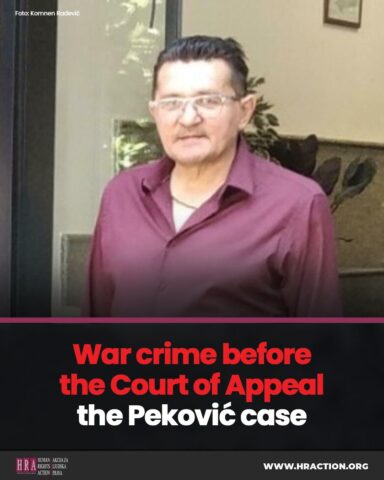
War crime before the Court of Appeal – the Peković case
Yesterday, the Court of Appeal of Montenegro held a main hearing in the appeal proceedings in the case of Slobodan Peković, who had previously been convicted at first instance and sentenced to 20 years in prison for a war crime against the civilian population in 1992 in Hum and Foča, Bosnia and Herzegovina.
In this case, the Court of Appeal opened the hearing on the appeals filed by the defence, represented by attorney Marijana Camović, and by Special Prosecutor Tanja Čolan-Deretić.
The defence claims that the accused Peković is not the person who committed the criminal offences. They dispute the description of him given by protected witnesses. The defence proposed that the court inspect a photograph of the accused Slobodan Peković from his military booklet, in order to establish his appearance during the relevant period based on the photograph, and this was done.
The prosecution objected to this evidence, stating that the military booklet indicates it dates from 1987, five years before the event with which Peković is charged. The legal representative of the injured party further pointed out that the photograph in the document is black-and-white and of limited evidentiary value.
Since Special Prosecutor Tanja Čolan-Deretić appealed the part of the first-instance judgment in which no decision was made on the injured party’s property-law claim, this issue was also raised before the Court of Appeal. The court decided that it would not conduct a new expert assessment of the injured party, but that a medical expert would provide an opinion on whether, based on the submitted medical documentation, there had been any change in her health condition compared with the earlier expert finding already contained in the case file.
The provision of such an opinion is a prerequisite for deciding on the request of the injured party’s legal representative, Dalibor Tomović, that the Court of Appeal, if it upholds the first-instance conviction, also decide on the property-law claim. This would be significant because it would avoid referring the victim to separate civil proceedings and subjecting her to further victimisation.
We recall that Slobodan Peković, who was previously surnamed Ćurčić, was sentenced by the High Court in Podgorica to 20 years in prison because, according to the indictment, as a member of the Army of Republika Srpska, he took part in an attack on the village of Hum near Foča in June 1992. At that time, together with other soldiers, he took Emina Šabanović out of a house, beating her all over her body with a shovel and dragging her by the hair, before taking her to the house of Mujo Šabanović, where he killed both of them by firing at them with an automatic weapon, and then set fire to the house with their bodies inside.
Peković was also found guilty of raping the injured witness A1. After she was forcibly brought to Foča, to the “Partizan” sports hall, Peković took her out of the hall together with her minor child, another witness, and several other women and children. He took them to an apartment across from the police station, where A1 was raped.
The High Court in Podgorica referred the injured party to civil proceedings to pursue her property-law claim. This move exposes the victim to further victimisation, because in order to obtain compensation for damages from Peković, she would have to initiate new proceedings, disclose her identity, and go through the trauma again, which constitutes a violation of the standards for the protection of victims of sexual violence. We believe that the court should have decided on the victim’s compensation claim within the criminal proceedings, because there was time to order an expert assessment of her psychological and physical condition, given the two “idle periods” during the trial lasting 19 months without a hearing being held. Since this was not done, we expect the Court of Appeal, if it upholds the conviction, to correct this omission.
The next main hearing is scheduled for 17 July 2026.









 English