At the Trial of Zoran Gašović, Three Witnesses from Bosnia and Herzegovina Heard; Defense Attorney Again Penalized for Leaving the Hearing
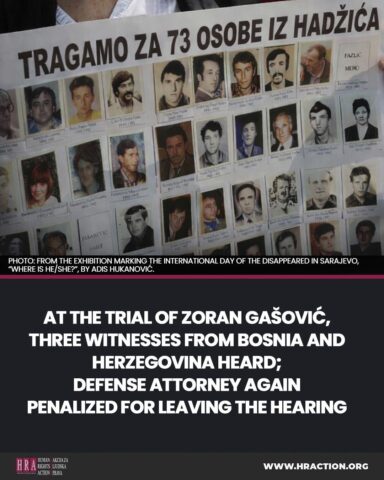
Today, the hearing of witnesses continued before the High Court in Podgorica in the trial of Zoran Gašović, who is charged with a crime against humanity committed in 1992 in Hadžići (Bosnia and Herzegovina).
This time, the court reduced the number of witnesses it decided to summon to four, but by 3 p.m., when the defense attorney left the courtroom, it managed to hear three of them, even though all four had traveled from Bosnia and Herzegovina for the second time. Defense attorney Danilo Mićović was again fined for leaving the hearing without authorization.
As in the previous session, representatives of the injured families testified, speaking about what they had heard from others regarding the suffering of their closest relatives. Victims have priority in giving testimony so that they may later follow the proceedings from the audience and ask questions of other witnesses.
Resul Kovačević testified that his father Alija, along with Alija Bašić and Ramiz Hrgić, were taken from the facility known as the “Garage” in Hadžići toward Mount Igman, where they were killed. Their remains were found in 1998. According to his knowledge, the abduction and killings were carried out by the accused Zoran Gašović and a certain Pušara. He said that Pušara likely suggested where to take them because he knew the terrain well, while Gašović had moved to Hadžići shortly before the war. “That they were taken away was confirmed to me by my late mother, who was also detained in the Garage. It was also confirmed by Z. Š., who saw it. I would suggest that she testify via video link, since she is an elderly woman,” Kovačević said.
Kovačević also stated that he assumes what the motive for his father’s killing was: “The day before, ten of my cousins were killed. They were surrounded, called upon to surrender, and then taken away and executed. Two of my brothers managed to escape. That is the reason why my parents were detained. In other families, all the sons had been killed. These two escaped, and then revenge against our family began.”
The witness also said he had heard that the accused Gašović helped place the bodies of his relatives into a refrigerated truck, burn them, and bury them.
Although the killings of the relatives and the removal of their bodies are not part of the indictment in this case, the court allowed questions related to that event, as well as, once again, questions from the defense attorney about whether this witness had also participated in the war.
Defense attorney Mićović insisted that the witness’s testimony was not consistent with the statement he had previously given during the investigation. He pointed out that the witness was presenting indirect knowledge, that a verdict could not be based on such testimony, and concluded that this was “a textbook example of false testimony.” Special Prosecutor Tanja Čolan-Deretić said that it was true that the witness had “spoken more broadly than before the Ministry of Interior of Bosnia and Herzegovina,” but that “it is legitimate for there to be differences in a witness’s account and for questions to be asked about them.” She emphasized that “the defense’s claim of false testimony represents nothing more than intimidation of the witness.”
Witness Advija Altoka testified about what happened to her husband Sakib. She stated that two uniformed soldiers took him from the parking area in front of their building in her presence, even though he was a civilian. From people who were later exchanged—especially M.M., Š. K., and A.B.—she learned that her husband had been beaten in the Garage, receiving blows to the spine, and that at one point “it cracked.”
“A.S. and A.D. saw him last in Lukavica, when a group of 46 people was taken away, including my husband. They are alive and can testify about that,” the witness said. She further stated that after their separation, A.D. was tasked with cleaning the room where they had been held because they had been told before leaving to leave their belts, sneakers, and shoelaces “because they would no longer need them.” Her husband has been listed as missing ever since.
Senija Musić, whose husband Suad is also among the group of 46 missing persons, asked Gašović to say where the bodies of those killed are located “so that their souls may find peace after so many years.” Gašović replied that he did not know. She stated that she learned about what happened in the Garage, Kula, and Lukavica eight months after the occupation, when her late brother-in-law was exchanged and told her everything. At that time, he told her that Gašović had mistreated everyone in the Garage and had not spared her husband either. The witness also stated that she knew they were all called out from a list in Kula—everyone was circled, including her husband.
According to the indictment, Gašović is also charged with participating in killings between May and the end of June 1992, and with committing enslavement, forced displacement, unlawful detention, torture, and interrogation of civilians in the facilities known as the Garage and the Sports Hall in Hadžići, as well as with the forced transfer of around 280 civilians to the “Slaviša Vajner Čiča” barracks in Lukavica.
He allegedly compiled a list of detainees and circled the names of 49 of them with a red pen, after which, on June 23, 1992, 48 were taken to an unknown location and are still listed as missing.
The special prosecutor in this case is Tanja Čolan-Deretić, while the trial panel is chaired by Judge Simo Rašović, with panel members Judges Ana Delić and Dragan Babović.
The next hearing in the main trial is scheduled for Friday, March 13.
Human Rights Action provides support to the injured parties in these proceedings in cooperation with the Association for the Search for Captured and Missing Persons from Hadžići, thanks to the support of the National Endowment for Democracy.




 English