Gašović Trial for Crimes in Hadžići – Testimony of Representatives of the Injured Nizić, Musić and Hrnjić Families
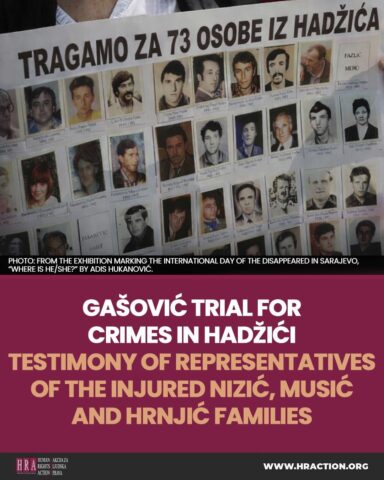
The trial of Zoran Gašović before the High Court in Podgorica, concerning charges of crimes against humanity allegedly committed in Hadžići (Bosnia and Herzegovina) in 1992, continued with the hearing of three witnesses.
As at the previous hearing, the witnesses were representatives of the injured families, who testified about what they had learned from others regarding the suffering of their closest relatives. Injured parties are heard first so that they may later follow the proceedings from the public gallery and put questions to other witnesses.
Witness Admir Nizić stated that on 14 June 1992, his father Fadil was taken away by members of a Serbian paramilitary unit, M. S., Đ. S., and others, together with Osman Nizić, Zejnil Merdžanić, and Ramiz Nizić. He said that M. S. fired at them with an automatic rifle and that all of them, except his father, died while being transported to the Health Centre in Hadžići.
His father Fadil was then transferred to the Sports Hall in Hadžići, and later to Lukavica, where he was called out and taken away, after which all trace of him was lost.
This witness also called on the accused, Zoran Gašović, to say, if he knew, where the bodies of the missing were located. In response, the accused stated that he did not know and that, before the court and the witnesses, he gave his word that if, from today onward, he were to receive any information about these events, and that he would make an effort to do so, he would inform both the court and the family members. “I will use all my human and material resources to prove that I did not participate in these events,” Gašović said.
Witness Adnan Musić stated that his father Sakib is still registered as a missing person. He said that information about his father’s arrest came from R. K., who told him that his father had been arrested by Zoran Gašović, D. P., and S. P., that they had tied him up with barbed wire even though they had other means of restraint, and that they had additionally abused him.
According to what he learned from surviving camp detainees and friends, his father was transferred from the Sports Centre in Hadžići, together with other detainees, to Lukavica, to the “Slaviša Vajner Čiča” barracks. There, as he stated, a group of 46 prisoners was separated on the basis of a list, although he does not know according to what criteria. That group was then taken away by bus, while the remaining prisoners were transferred to the Kula facility. He pointed out that more than 200 detainees had been brought from Hadžići to Lukavica and that, according to witness statements, he knew Gašović had participated in their transport. He added that he did not know what happened afterwards to the separated group, whose members are still listed as missing today.
Defence counsel Danilo Mićović pointed out that the witness had been only eleven and a half years old at the time of the events, that he had no direct knowledge, and that a judgment could not be based on indirect information.
Witness Kadir Hrnjić stated that he, his brother Enes, and their father were arrested in late May or early June 1992 by armed soldiers, among whom were D. K. and N. J. They were taken to the Hadžići municipal building, where they were separated, and from that moment he never saw his father again. As he later learned, his father had been held in a facility about 200 metres from the garage, in the former Territorial Defence premises, while he and his brother remained in the municipal building, where they were questioned. He was later taken to the “Garage” camp, which, as he described it, was a space intended for a single vehicle but held around 40 detainees. He said that the conditions there were extremely poor: it was stifling and hot, the detainees were dirty and neglected, and they relieved themselves in bottles.
He left the camp the same day thanks to S. P., whom he had known from before, who recognized him and took him out of the facility, and then drove him home.
The witness stated that Zoran Gašović later came to his door looking for weapons, in the period after his release from the camp and before he and his family left Hadžići. He said that Gašović forced him to search for weapons in nettles for more than half an hour, as a result of which he was badly stung, after which he found a buried pistol and handed it over to him.
After that, S. P. helped him and his family leave Hadžići and drove them to the demarcation line.
He also stated that later, during 1993, he learned from M. P. that his father had been killed by Zoran Gašović and a certain K. in the Territorial Defence premises in Hadžići.
Following this, defence counsel Danilo Mićović filed a criminal complaint against the witness for allegedly giving false testimony, on the grounds that he had allegedly never previously mentioned Gašović as someone who killed his father, and that in an earlier statement he had said only that his father had been “beaten to death,” which, according to the defence, could only be understood as meaning that he had been severely beaten.
The witness explained that during the exhumation it was established that his father had all ribs on the left side broken, a spinal fracture at the fourth vertebra, and that, according to the findings, the fatal injury was a blow to the area of the heart. He said that he had no knowledge of the manner in which Gašović had struck his father and that everything he stated came from M. P.
He added that his brother Enes is still listed as missing and is among the group of 46 missing persons from Lukavica who are still being searched for.
According to the indictment, Gašović is charged with having, from May to the end of June 1992, participated in killings, enslavement, forced displacement, unlawful detention, torture, and interrogation of civilians in the “Garage” facility and the Sports Hall in Hadžići, as well as in the forced transfer of around 280 civilians to the “Slaviša Vajner Čiča” barracks in Lukavica. He is also accused of compiling a list of detainees on which he circled 49 names in red pencil, after which, on 23 June 1992, 48 persons were taken to an unknown location and have remained missing to this day.







 English