A Key Step Closer to Erecting a Memorial to the Victims of the 1992 Deportation
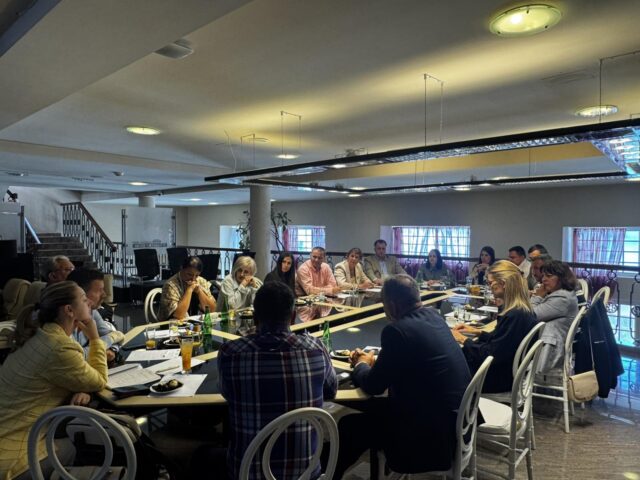
On the occasion of the initiative to erect a memorial to the victims of the 1992 deportation of Bosnian-Herzegovinian refugees in Herceg Novi — an initiative championed since 2010 by the families of victims of that war crime and the non-governmental organisations Human Rights Action (HRA), the Centre for Civic Education (CGO), and the Centre for Women’s and Peace Education – ANIMA — a meeting was held today in Herceg Novi between members of the local parliament, the Minister of Culture and Media Tamara Vujović, representatives of HRA and ANIMA, and Alen Bajrović, the son of a victim of the deportation.
The meeting was attended by representatives of the following council groups: Democratic Montenegro (Slavka Zambelić, Nikola Samardžić), the Novi List (Miloš Konjević – President of the Municipal Assembly, Jovan Subotić, Vojislav Ilić, Mira Vujović, Jasmina Konjević, Dragana Stanišić), the Democratic Party of Socialists (Dejan Stojadinović, Nebojša Kaluđerović), the European Alliance (Tanja Vujičić and Dejan Radulović, coordinator of the municipal board), the Civic Movement for Herceg Novi “Idemooo” (Olivera Doklestić), and URA (Nikola Radman). Also present was Nebojša Mandić, a journalist and citizen of Novi, who has attended memorial gatherings in front of the Herceg Novi Security Centre since 2010.
All those present expressed support, through discussion, for the submission of a proposal to the Council for Naming Settlements, Streets and Squares of the Herceg Novi Municipal Assembly for the erection of a memorial to the victims of the 1992 refugee deportation in front of the Security Centre building in Herceg Novi, and for such an initiative to be co-signed by the presidents of the council groups.
Readiness was expressed to refer this initiative to the Council and then to the Municipal Assembly, so that the memory of the deportation victims may be marked in an institutional and lasting manner, paying tribute to those who perished and to their families, and so that the current Assembly convocation may demonstrate a dignified attitude towards the victims and towards the crime that has left many families in enduring grief. It was also emphasised that the memorial should carry a message of unity, one that stands against crime and sends a message to future generations that nothing similar should ever happen again.
In order to reach a consensual solution, it was proposed that a Working Group be formed at the level of the Assembly Presidency to agree on the text to be incorporated into the memorial.
This show of support represents a pivotal step in the years-long efforts of the victims’ families and the organisations Human Rights Action (HRA), the Centre for Civic Education (CGO), ANIMA, and civic activist Aleksandar Saša Zeković, who have continuously highlighted since 2011 the need to provide the victims with a dignified memorial at the site from which they were unlawfully taken.
During the meeting, the findings established by final judgment of the Higher Court in Podgorica were presented: in late May 1992, civilians who had previously fled to Montenegro from Bosnia and Herzegovina were systematically, unlawfully and forcibly removed from Herceg Novi, which served as a collection centre of the Ministry of Internal Affairs; the majority of those civilians subsequently perished in camps of the Army of Republika Srpska and at an unknown location near Bratunac.
Also presented at the meeting were the results of a public opinion survey conducted in Herceg Novi in April 2024, according to which slightly more than one third of the city’s residents were in favour of erecting a memorial, slightly fewer than one third were opposed, while the remainder were neutral as they did not have sufficient information about the event.
A video recording was shown from last year’s memorial gathering in Herceg Novi, at which the mothers of two deportation victims — Hikmeta Prelo (mother of eighteen-year-old Amer) and Sejda Krdžalija (mother of twenty-year-old Sanin) — spoke about the significance of erecting a memorial for the families of those who perished, whose mortal remains have still not been found. The mothers emphasised in particular that they do not hold the city of Herceg Novi responsible in any way, that this could have happened in any city, but that a memorial there would mean a great deal to them because that is where they last saw their children.
The meeting was organised as part of Human Rights Action’s project “Together for Lasting Peace through Education, Dialogue, and Memorialization”, within the regional project “EU Support for Trust Building in the Western Balkans”, funded by the European Union and implemented by the United Nations Development Programme (UNDP). The views expressed during this meeting are those of the participants and do not necessarily reflect the views of Human Rights Action, the European Union or UNDP, nor should they be considered their official positions.








 English