Murino: 27 Years Since the NATO Bombing – No Criminal Accountability and No Full Redress
Twenty-seven years after six civilians, including three children, were killed in the NATO bombing of the bridge in Murino, no one in Montenegro has been held accountable for the failures that led to the loss of human lives, nor have reparations been paid.
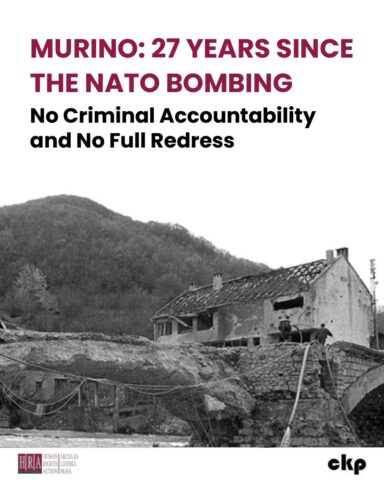
In the bombing of the bridge in the town of Murino on 30 April 1999, the following civilians were killed: Miroslav Knežević (14), Olivera Maksimović (13), Julija Brudar (11), Vukić Vuletić (46), Milka Kočanović (69), and Manojlo Komatina (72). Eight more people were injured.
In addition to the bridge, other civilian structures were damaged, including a shop and the local Cultural Centre. Air raid sirens were not sounded, nor was any other warning of danger given — a fact confirmed by a court ruling.
NATO stated that it had informed the competent Montenegrin authorities of planned targets; however, the residents of Murino were not notified. The affected families sued Montenegro for damages resulting from the failure to warn civilians. Although one family’s claim was upheld by a final judgment, the Supreme Court of Montenegro subsequently overturned that decision on appeal and effectively barred all other victims from obtaining redress, citing the statute of limitations, which had run precisely because criminal proceedings were never brought against those responsible for the failure to warn the public.
The tragedy in Murino is not an isolated case in the region. On the night of 22–23 April 1999, NATO bombed the building of Radio Television of Serbia (RTS) in Belgrade, killing 16 employees. In that case too, the relevant authorities had been informed in advance of the planned attack, yet failed to evacuate the workers. Unlike Montenegro, however, the Serbian judiciary acted following the change of government on 5 October 2000: in 2002, the District Court in Belgrade convicted the then-director of RTS, Dragoljub Milanović, to 10 years in prison for a serious criminal offence against public safety, having failed to order the evacuation of employees. He served his full sentence after being arrested in Montenegro in 2003.
This case illustrates how Montenegro should have acted, on the similar legal basis and on very similar facts. The question remains why that basis was never applied or investigated in Montenegro.
Last year, a quarter of a century after the attack, the victims of the NATO bombing in Murino and their families were recognised as civilian war victims through an amendment to the Law on Veterans’ and Disability Protection. The Government also adopted a decision to pay one-off grants of €100,000 to the families of those killed, as compensation for the social protection they had been denied as civilian victims throughout all the preceding years. These steps represent significant progress towards acknowledging responsibility for years of injustice. Nevertheless, the families of the killed and the surviving victims have been left without compensation for non-pecuniary damage — for the pain and suffering caused by the loss of life and the injuries sustained.
Human Rights Action and the Montenegrin Committee of Lawyers for Human Rights call on the State Prosecutor’s Office of Montenegro to examine and inform the public whether the Prosecutor’s Office has ever addressed the question of accountability for the failure to warn civilians in Murino, and why criminal investigations in this case were never initiated.
We recall that our organisations have repeatedly warned the State Prosecutor’s Office — both publicly and through direct communication — of the possible existence of criminal liability for the failure to warn citizens of the danger of the NATO attack, yet no information was ever made public as to whether any action was taken in that regard.
We also call on the newly established Commission for Compensation of War Crime Victims, established by the Ministry of Justice, to consider whether the families of those killed in Murino are owed satisfaction of a natural obligation of compensation for damages.
Justice for the victims requires both criminal accountability and adequate reparations for all harm suffered.









 English