The Police Director Must Tolerate a Higher Level of Criticism in Political Speech
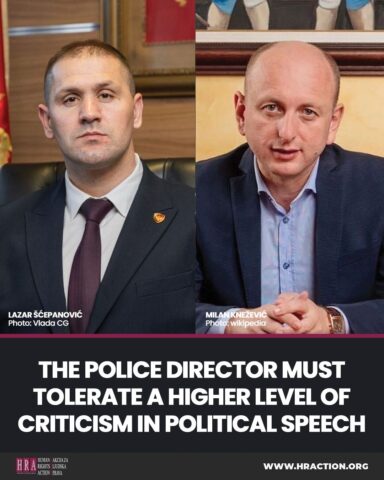
Human Rights Action expects the Police Directorate to take into account European standards on freedom of expression and to withdraw the misdemeanor proceedings against Member of Parliament Milan Knežević for allegedly insulting its director, especially since in this case it may also be considered an abuse of the apparatus of state repression to protect the personal feelings of the police director.
Public officials, including the Director of the Police Directorate, must tolerate a higher level of criticism, including harsh or offensive rhetoric, within political debate in a democratic society.
Democratic People’s Party MP Milan Knežević was notified on February 27, 2026, that officers of the Podgorica Security Department had filed a request to initiate misdemeanor proceedings against him before the Misdemeanor Court in Podgorica for the offense of gross insult in a public place, under Article 7(2) of the Law on Public Order and Peace, to the detriment of the Director of the Police Directorate, Lazar Šćepanović.
The proceedings were initiated because of a statement Knežević made on December 31, 2025, during the citizens’ protest in Zeta.
On that occasion, while criticizing the police’s treatment of citizens, Knežević referred to the police director by the nickname “Bukva” (“Beech”).
Although this expression may be perceived as offensive, according to the established case law of the European Court of Human Rights, freedom of expression also protects speech that includes a certain degree of insult, exaggeration, or provocation when it concerns matters of public interest.
In this case, the disputed expression was used in the context of a political protest and criticism of the police’s conduct toward citizens. Since the statement refers to a high public official, the threshold of permissible criticism is considerably broader.
For example, in the judgment Oberschlick v. Austria (No. 2), the European Court of Human Rights found that calling a politician an “idiot” could be permissible in political debate. In Gaspari v. Armenia (No. 2), the Court also concluded that expressions such as “hooligan,” “idiot,” “beast,” or “scum,” directed at a police chief during a protest, may form part of political criticism of the authorities that must be tolerated. Similarly, the Court held that the local president of the Greens in Croatia should not have been punished for insult even though, during a political debate, he referred to the mayor as a “cockroach” (Bon v. Croatia).
In the judgment Castells v. Spain, the Court emphasized that freedom of expression is particularly important for elected representatives of the people, as they represent the interests of their voters and draw attention to matters of public interest.
Initiating misdemeanor proceedings over such an expression constitutes a disproportionate restriction on political speech and departs from the freedom of expression standards established by the European Court of Human Rights. Such a police action may also be interpreted as an abuse of the apparatus of state repression aimed at protecting the personal feelings of the police director.
We expect the Police Directorate to reconsider its decision and withdraw the misdemeanor proceedings.
If this does not happen, the Misdemeanor Court in Podgorica has the obligation to properly consider and apply all relevant standards of the European Court of Human Rights in order to protect freedom of expression in political debate.




 English