Statement by HRA Executive Director Tea Gorjanc Prelević concerning her detention at Belgrade Airport
We are publishing in full the statement given to Vijesti by Human Rights Action Executive Director Tea Gorjanc Prelević, who, upon arriving from Montenegro at Belgrade Nikola Tesla Airport on Monday, 27 July 2026, was singled out and detained at border control without any explanation, while her minor children were allowed to enter Serbia:
Gorjanc Prelević: I Cannot Pose Any Threat to Serbia’s Security
Upon arriving from Montenegro, Human Rights Action (HRA) Executive Director Tea Gorjanc Prelević was, without any explanation or formal decision, “singled out” at the border crossing, while her minor children were allowed to enter Serbia. She assumes that this may be related to an entry in the records of the Security Intelligence Agency (BIA)
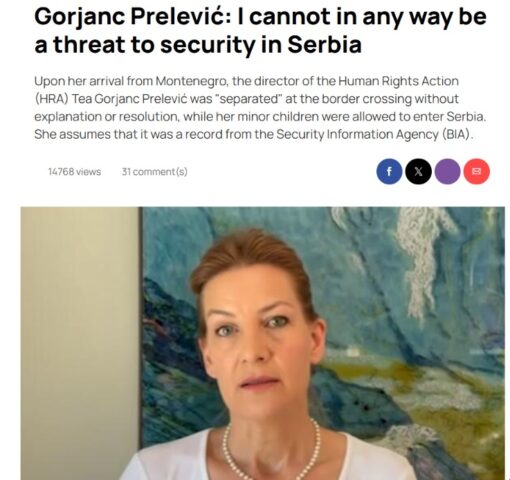
Gorjanc Prelević, Foto: Screenshot/TV Vijesti
Following three entry bans imposed on journalists and civil society activists within the space of a month, new tensions have arisen at the border between Montenegro and Serbia. Human Rights Action (HRA) Executive Director Tea Gorjanc Prelević was detained yesterday at Belgrade Airport. As she was given neither an explanation nor a formal decision, she believes the measure was politically motivated. Despite everything that has been happening since June, the Montenegrin authorities have failed to respond adequately, although they should have done so, opposition representatives say, adding that they also view the silence as a response in itself. Gorjanc Prelević, however, will not wait for them and intends to pursue her case through the appropriate legal procedures.
Yesterday afternoon, Gorjanc Prelević spent approximately an hour in a police room at Belgrade Nikola Tesla Airport.
Upon arriving from Montenegro, she was “singled out” at the border crossing without any explanation or formal decision, while her minor children were allowed to enter Serbia. She assumes that this may be related to an entry in the records of the Security Intelligence Agency (BIA).
“I believe this was entirely arbitrary conduct—an arbitrary detention that is contrary to internationally recognised human rights standards. I will contribute to democratisation and the rule of law in Serbia by pursuing this case and seeking an explanation as to why I was treated in this manner. I do not believe that I can pose any threat whatsoever to Serbia’s security,” Gorjanc Prelević told Television Vijesti.
Gorjanc Prelević believes that her criticism of the policies pursued by the Serbian regime, as well as her support for students, the victims of the Srebrenica genocide and the protection of human rights, cannot constitute a legitimate reason for yesterday’s detention.
“That must not be the result of my expressing support for the protection of the human rights of all critics of the Serbian regime from Montenegro who have also been denied entry. Advocating for human rights must not be regarded as a threat to the security of a democratic state, as Serbia presents itself to be,” she said.
The latest tensions at the border follow several entry bans imposed on journalists and civil society activists over the past month. At the end of June, while leaving Serbia, Petar Komnenić, a journalist and the host of Television Vijesti’s programme Načisto, was served with a decision banning him from re-entering the country. At the beginning of this month, BIRN Executive Director Vuk Maraš received the same decision at Belgrade Airport, while RTV Podgorica Director Vladimir Otašević was denied entry last week.
These measures were introduced in retaliation, as announced by Serbian President Aleksandar Vučić, after the Montenegrin police banned Dragan J. Vučićević, editor of the Serbian tabloid Informer, from entering Montenegro. Although the Serbian authorities have continued imposing entry bans ever since, Vučić recently called on Montenegro to ease its measures.
“I believe they will stop applying those measures, because that would, I believe, make it possible to withdraw the reciprocal measures within a relatively short period of time,” Vučić said on 4 July.
While Vučić has spoken about the issue on several occasions, Montenegrin officials have remained silent for some time, reacting only vaguely after Komnenić was banned from entering Serbia. Prime Minister Milojko Spajić said that the professional work of the host of Načisto could not be equated with the conduct of Vučićević, who insults Montenegro. Nevertheless, the state has failed to take any concrete action throughout this period.
Members of the ruling majority declined to comment on the matter today, while opposition representatives stressed that an adequate response should have followed the first incident. They said that, after everything that has happened, it is clear that respect for human rights is being called into question both in Serbia and in Montenegro.
“When someone who is, in fact, a human rights defender, such as Ms Gorjanc Prelević, or representatives of the media, is subjected to a situation like this—one that above all undermines their human dignity—it becomes clear what the attitude is towards critical thought and towards those who think freely. As I have said, the political message is clear, and that is precisely why there is no explanation. That is why there is silence,” said Zoja Bojanić Lalović, an MP from the Democratic Party of Socialists (DPS).
By remaining silent, the DPS MP stressed, the state is sending a clear message that it approves of this pattern of conduct.
“That anyone who dares to think or speak differently from what is expected may end up being treated in this way,” Bojanić Lalović said.
Unlike the authorities in Podgorica, which have remained silent, Brussels has expressed concern over the reciprocal entry bans imposed on journalists, warning that measures restricting the work of the media are not consistent with the values expected of candidate countries for membership of the European Union (EU). The European Commission told Radio Free Europe that it would continue to closely monitor developments and called on Serbia and Montenegro to engage in resolving the outstanding issues.
In conclusion, Gorjanc Prelević reiterated that she would make every effort to clarify the matter and find out why she had been detained in the border police premises, although she believes the grounds for doing so were arbitrary.
“I believe the grounds were political, that the aim was to intimidate critics of Aleksandar Vučić, and I will devote myself to ensuring that such practices come to an end,” Gorjanc Prelević said.







 English