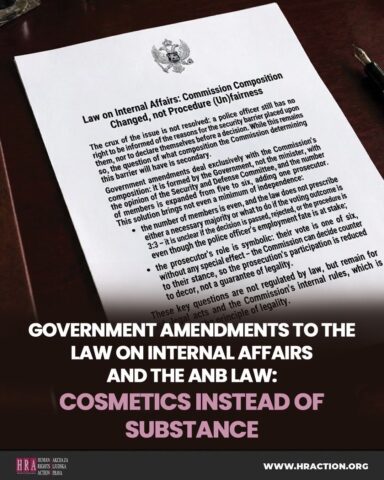
Government amendments to the Law on Internal Affairs and the ANB Law: cosmetics instead of substance
The draft laws amending the Law on Internal Affairs and the Law on the National Security Agency (ANB), which the Government submitted to the parliamentary procedure today, do not deliver what was announced by the Agreement on Overcoming the Parliamentary Crisis – genuine guarantees of due process and privacy.
Instead, both proposals address only part of the problem, while key shortcomings remain untouched.
Law on Internal Affairs: the Commission’s composition changes, but not the (un)fairness of the procedure
The core problem has not been solved: a police officer still has no right to be informed of the reasons for the security impediment held against them, nor to respond to them before a decision is made. As long as that remains the case, the composition of the Commission that determines such impediments is a secondary issue.
The Government’s amendments deal exclusively with the Commission’s composition: it will now be formed by the Government rather than the minister, with an opinion from the Security and Defence Committee, and its membership will expand from five to six through the addition of one prosecutor. This solution does not provide even a minimum level of independence:
The number of members is even, and the law prescribes neither the required majority nor the outcome of a 3:3 tie – it is unclear whether the decision is deemed adopted, rejected, or whether the procedure is repeated, even though a police officer’s employment status is at stake;
the prosecutor’s role is symbolic: their vote is just one of six, with no special effect – the Commission can decide against their position, reducing the prosecution’s participation to decoration rather than a guarantee of legality.
These key questions are not regulated by law at all, but are left to bylaws and the Commission’s internal rules, which is contrary to the principle of legality.
HRA’s amendments called for what is missing: a mixed, seven-member, depoliticized Commission (alongside police officers, including a retired judge, a lawyer, a law professor or a civil society representative, and a representative of the Protector of Human Rights and Freedoms); clear procedural principles – adversarial proceedings, proportionality, a reasoned decision, the right to an effective defence; a five-year mandate with a ban on arbitrary dismissal; the candidate’s right to be informed of the reasons for the impediment, not merely its existence – something the Ombudsman has repeatedly found to be a constitutional obligation; a statute of limitations for the events on which an impediment may be based; access to the case file subject to judicial control of confidentiality; an oral hearing; and the right to an effective remedy and compensation.
None of this has been included in the current proposal. The Commission remains a body under the dominant influence of the executive, without clear decision-making rules and without real protection of police officers’ rights.
ANB Law: a partial step forward, the substance of oversight unchanged
The same pattern – partial and inconsistent fixing – is present in the amendments to the ANB Law.
It is positive that the Government introduced judicial oversight over access to the most sensitive personal data of individuals (genetic and biometric data, profiling) and over access to location data, abolishing the ANB director’s former authority to decide on this alone. This fulfils part of the obligations arising from the Constitution, Constitutional Court rulings, and international standards.
But the most dangerous points of the secret surveillance system remain untouched:
The ANB can still apply the most invasive secret surveillance measures without a prior court decision, for up to 48 hours, with judicial review only afterward. HRA had called for aligning this model with the Criminal Procedure Code: in genuinely urgent cases, a court issues an oral order before the measure begins, and a written decision follows within 12 hours – otherwise the measure is halted and the collected data destroyed. Keeping the 48-hour “window” without a prior oral court order means that deep intrusions into privacy – including communications surveillance – can still take place without real judicial control.
Article 18 of the ANB Law, which governs recording, tracking, and observation measures, has not been touched at all. These measures, although formally carried out in public spaces, allow for the prolonged, systematic collection of data on people’s movements, contacts, and behaviour, striking at the very core of the right to privacy. HRA had called for these measures, too, to be subject to prior judicial control.
By keeping the existing arrangement, one of the deepest forms of intrusion into privacy continues to be decided solely by the executive branch – something already criticized by the UN Special Rapporteur on the right to privacy.
It is now the responsibility of the Parliament and its members to, by adopting the amendments HRA has submitted, refine the proposed solutions and bring them into line with the Constitution of Montenegro, international human rights standards, and the case law of the European Court of Human Rights.









 English