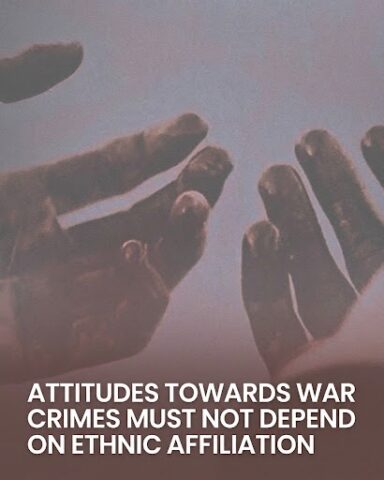
ATTITUDES TOWARDS WAR CRIMES MUST NOT DEPEND ON ETHNIC AFFILIATION
Non-governmental organisations and civic activists strongly condemn the statements by Deputy Prime Minister Nik Gjeloshaj and Deputy Speaker of Parliament Nikola Camaj, which relativised the first-instance judgment of the Kosovo Specialist Chambers in The Hague against Hashim Thaçi, Jakup Krasniqi, Kadri Veseli and Rexhep Selimi.
The offices of Deputy Prime Minister and Deputy Speaker of Parliament carry particular weight, as their holders represent the face of the Montenegrin state. Through their inappropriate statements, Gjeloshaj and Camaj joined representatives of the ruling majority from other parties who likewise deny war crimes, glorify perpetrators and show no respect for the rule of law. They also prompted a wave of similar statements by other public officials from their political groups.
An independent judiciary is the foundation of every democratic society and of the international legal order. Court decisions, including those concerning members of the ethnic community to which a public official belongs or which they politically represent, must be respected as the outcome of a legal process based on evidence, and not assessed through the prism of ethnic or political affiliation.
A public official who equates individual responsibility for war crimes established at first instance with an entire nation does not protect the interests of the citizens they represent, but undermines trust in the legal system and sends a dangerous message that attitudes towards a crime may depend on who committed it.
We recall that, until the judgment becomes final, it remains subject to appeal and the accused retain the right to pursue further legal remedies. However, the right of appeal and the presumption of innocence until a judgment becomes final must never be misused as a pretext for publicly denying the legitimacy of the court, discrediting the judicial institution, or celebrating those convicted as heroes.
It is particularly concerning that such statements come from holders of some of the highest state offices in Montenegro. They cannot be reduced to expressions of an individual’s personal grief, as some seek to portray them, because they are made by officials whose words carry particular institutional and political weight. Such messages are incompatible with Montenegro’s obligation, in the final stage of European integration, to consistently uphold the rule of law, the principle of individual responsibility, and respect for the decisions of national and international courts.
For all these reasons, we once again call on the Government of Montenegro and Prime Minister Milojko Spajić to take a clear, institutional and principled position on this issue as well. Montenegro cannot base its approach to court judgments on the ethnic affiliation of those convicted.
We also recall that behind every war-crimes judgment are specific victims and their families, whose right to truth and justice must not be overshadowed by day-to-day political reactions.
Non-governmental organisations and civic activists remain committed to the principle that war crimes have no nationality and that individual guilt cannot be turned into collective guilt. No perpetrator is “ours”, while every victim is.
Non-governmental organisations and civic activists:
1. Dina Bajramspahić
2. Centre for Civic Education (CCE)
3. Human Rights Action (HRA)
4. Juventas
5. Centre for Monitoring and Research (CeMI)
6. Montenegrin LGBTIQ Association Queer Montenegro
7. Centre for Democracy and Human Rights (CEDEM)
8. Municipal Multiple Sclerosis Association Bijelo Polje
9. Safe Women’s House
10. Youth Activism Network of Montenegro (MOACG)
11. 35mm
12. Roma youth organisation “Walk With Us – Phiren Amenca”
13. Multimedijal
14. Fund for Progressive Policies
15. Civic Initiative 21 May
16. Centre for Democratic Transition (CDT)
17. Montenegrin PEN Centre
18. Antifascists of Cetinje
19. Husein Paša – Pljevlja
20. Montenegrin Women’s Lobby
21. Mogul
22. Bonum
23. Prima
24. Women’s Rights Centre (CŽP)
25. Active Zone
26. Spektra
27. Centre for Investigative Journalism of Montenegro (CIN CG)
28. Ikre Rožaje
29. Association “Štrpci – Against Oblivion”
30. Ipso Facto
31. ANIMA – Centre for Women’s and Peace Education
32. Women’s Action
33. Association of LBTQ Women “Stana”
34. Centre for the Development of NGOs (CRNVO)
35. Green home
36. Alternative Theatre Active Company (ATAK)
37. Montenegrin Society of Independent Writers
38. Montenegrin Media Institute
39. Local Democracy Agency Nikšić
40. Jovana Marović
41. Paula Petričević
42. Biljana Maslovarić
43. Sabina Talović
44. Danijel Kalezić
45. Emir Pilav
46. Almedina Dodić
47. Milena Bešić
48. Nikoleta Đukanović
49. Dušan Pajović
50. Milica Kankaraš Berber
51. Goran Đurović
52. Nataša Nelević
53. Vesna Rajković Nenadić
54. Mato Kankaraš
55. Milo Perović




 English