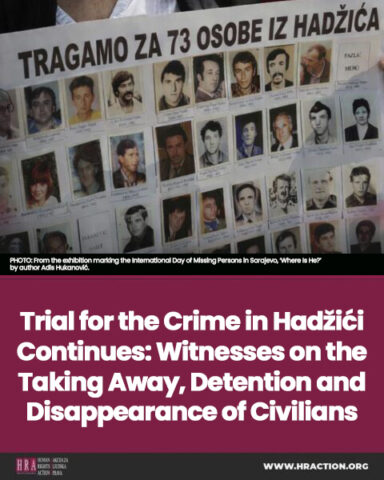
Trial for the Crime in Hadžići Continues: Witnesses on the Taking Away, Detention and Disappearance of Civilians
The trial of Zoran Gašović continued before the Higher Court in Podgorica with the hearing of three witnesses. Gašović is charged with a crime against humanity committed in 1992 in Hadžići, Bosnia and Herzegovina.
Two representatives of the injured families testified about what they knew regarding the suffering of their loved ones, as did one witness/injured party. In accordance with procedural rules, injured parties have priority in giving testimony, so that they may subsequently follow the trial from the audience and ask questions of other witnesses.
Azra Smajić, the daughter of the missing Nijaz Čiko, said she had come to the trial in Podgorica in order to finally find out where the remains of her loved ones are, “so that we can bury them and their souls can find peace.” She stated that she did not remember the exact date, but that her father was taken from the family home in Hadžići in May 1992. She said the family had no information about his fate for a long time, until they heard from her now late uncle Fadil Čiko that he had seen him in the Garage where prisoners were being held. “He did not recognize him immediately, until my father said to him: ‘Uncle, it’s me, Nijaz.’ He had been beaten so badly,” Smajić recounted. According to her, they later learned that Nijaz had also been detained in facilities in Kula and Lukavica. She added that her uncle had also been there, but that he never wanted to speak about who had tortured her father, probably in order to protect the family.
Witness Amra Halvadžija, daughter and sister of the killed Adil and Edin Kadrić, stated that her father and brother disappeared in Hadžići after being taken from the family home. She emphasized that she was present when unknown men took her father away. “My last memory of my father is of him being led down the yard with his hands raised in the air,” she said.
She stated that her brother Edin was first taken to the Garage, where he spent one day, after which he was returned to house arrest. During his time in the Garage, he saw his father in an extremely grave condition. “He had been beaten, was hungry, bloody, and covered in bruises,” the witness recounted. During Edin’s house arrest, various people came to the house, including, as she stated, the defendant Gašović, although she did not know what they discussed.
Since her mother recently passed away, the witness proposed that her mother’s statement also be read later in the proceedings, noting that her mother had more detailed knowledge. She explained that, in her own testimony, she would also present what she had heard from her mother, because for one period she had not been in Hadžići.
According to this information, as she stated, Gašović took her brother from house arrest to the Garage, where other detained persons were also being held, after which they were transferred to the Sports Hall and then to the Kula facility in Ilidža. She also said that a group of 46 people was then taken to Lukavica, where, according to the testimony of exchanged prisoners, they were subjected to severe torture. “Screams and cries could be heard, and later a pile of clothing was found, indicating that they had been stripped naked in order to conceal traces,” she stated. She added that all trace of that group has been lost since then.
The defendant’s counsel, lawyer Danilo Mićović, objected in full to this part of the testimony, stating that it was instructed and aimed at worsening Zoran Gašović’s position, especially because the witness had not mentioned him earlier. She responded by saying that before the Prosecutor’s Office of Bosnia and Herzegovina she had spoken only about her direct knowledge, while before the court she also presented what she had heard from her mother, which is why she had proposed that her mother’s statement be read as evidence.
Defence lawyer Danilo Mićović again proposed that the entire proceedings be audio-visually recorded, although the Court had previously rejected such a proposal.
Witness Nihad Bećirović stated that he had known the defendant Zoran Gašović from before, since their youth, saying that they used to socialize and swim together in the river. He recounted that in May 1992 he left Ilidža and went to the family house in Breza, where, he claims, the defendant visited him and asked him for weapons. “I said I had none, that I did not live there. Then he slapped me to make me admit where the rifle was. That was all the contact we had,” the witness stated. As for the treatment of others, he said that he did not know whether the defendant Gašović had participated in interrogations, detentions, transfers, and forced resettlements of prisoners.
According to the indictment, Gašović is charged with having participated, from May until the end of June 1992, in killings, enslavement, forcible transfer, unlawful imprisonment, torture, and interrogation of civilians in the “Garage” and Sports Hall facilities in Hadžići, as well as in the forcible transfer of around 280 civilians to the “Slaviša Vajner Čiča” barracks in Lukavica. He is also charged with compiling a list of detainees on which he circled 49 names in red pencil, after which, on 23 June 1992, 48 persons were taken to an unknown location and remain missing to this day.
The continuation of the trial is scheduled for 27 May.







 English