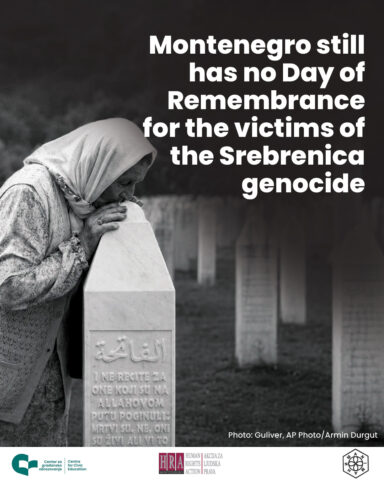
Montenegro still has no Day of Remembrance for the victims of the Srebrenica genocide.
Montenegro has not officially established 11 July as the Day of Remembrance for the victims of the Srebrenica genocide this year either, which would ensure its regular institutional commemoration.
Although the Parliament of Montenegro previously, in its 2021 Resolution on the Genocide in Srebrenica, recognized the importance and need to establish 11 July as the Day of Remembrance for the victims of the Srebrenica genocide, and although Montenegro in 2024 supported the Resolution of the United Nations General Assembly declaring 11 July the International Day of Reflection and Commemoration of the 1995 Genocide in Srebrenica, our state has still not officially designated this memorial day.
On 11 June, Human Rights Action (HRA), the Centre for Civic Education (CCE) and the Centre for Women’s and Peace Education – ANIMA addressed the Prime Minister, the Speaker of Parliament, the Minister of Foreign Affairs, and the Minister of Human and Minority Rights, asking whether the state would nevertheless mark 11 July this year. To date, we have received only a response from the Ministry of Foreign Affairs and informal information from the Office of the Deputy Speaker of Parliament, Mirsad Nurković.
The Ministry of Foreign Affairs informed us that, in cooperation with the Office of the United Nations Resident Coordinator in Montenegro, it will organize a panel discussion on the genocide in Srebrenica, responsibility for its prevention, and the importance of preserving memory as a prerequisite for a safer future and coexistence, on Friday, 3 July.
The Office of Deputy Speaker Nurković unofficially informed us that an exhibition on Srebrenica is being prepared and is expected to be displayed in the hall of the Parliament.
We welcome these activities as a contribution to nurturing a culture of remembrance.
However, we have not received an answer to the question of establishing a Day of Remembrance.
The establishment of a day of remembrance is not a precedent in the practice of the Parliament of Montenegro, but, unfortunately, it is subject to political calculation. This is also confirmed by the 2024 Resolution on the Genocide in the System of Camps of Jasenovac, Dachau, and Mauthausen, which determined that “22 April shall be officially recognized as the Day of Remembrance for the victims of the genocide in Jasenovac, to be marked every year.” Therefore, there is no justified reason why 11 July should not also be established as the Day of Remembrance for the victims of the Srebrenica genocide, especially since the Parliament itself set this obligation five years ago.
We call on the Government and the Parliament of Montenegro to proclaim 11 July the Day of Remembrance for the victims of the Srebrenica genocide without further delay and to ensure its regular institutional commemoration, in accordance with Montenegro’s international and domestic obligations. In doing so, the state would demonstrate consistency with its own decisions, reaffirm its commitment to the universal values of human rights, and send a clear message that nurturing a culture of remembrance and respecting the victims are not matters of political will, but of civilizational responsibility, which requires a clear rejection of the denial and relativization of genocide.








 English