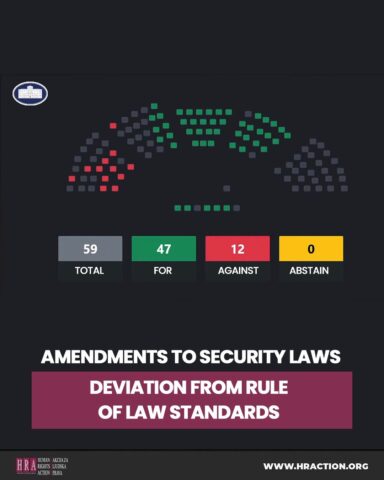
Amendments to Security Laws – Deviation from Rule of Law Standards
By adopting amendments to the Law on Internal Affairs and the Law on the National Security Agency, the Montenegrin authorities have allowed party dominance over the security sector at the expense of human rights to a fair trial, privacy, and judicial oversight of government actions.
Instead of respecting human rights, it has been allowed for police officers to lose their jobs through a secret procedure for determining “security obstacles,” in which they are not informed of the allegations against them nor given the opportunity to respond to those allegations.
Instead of strengthening police professionalism and preventing discrimination, further non-transparent employment under political control has been enabled.
Broad powers for officers of the National Security Agency (ANB) to access sensitive citizens’ data without prior judicial oversight have been retained. An opportunity for a fundamental democratic reform of the state intelligence service has been missed; it continues to function through changes in leadership but without essential institutional reform.
Such strengthening of political control over the security sector is occurring in the sixth year since the so-called historic change of government in Montenegro, when citizens were promised only democratic reforms.
Both laws were adopted despite warnings from domestic and international organizations. The absence of a clear demand from the European Commission that the disputed provisions be aligned with European standards before their adoption is concerning.
The legislative amendments deviate from rule of law standards that Montenegro claims it seeks to achieve. It is realistic to expect that they will lead to the dismissal of dozens of police officers, who will ultimately successfully challenge those decisions before the Constitutional Court. A climate of mistrust, party loyalty, and legal uncertainty will prevail instead of the professionalization of the Police Directorate and the National Security Agency as democratic institutions.
Specifically, the following solutions have been introduced.
Amendments to the Law on Internal Affairs allow the Ministry of Internal Affairs, until 2027, to employ police officers without external oversight from the Human Resources Administration, without a staffing plan, and without public announcements of vacancies, according to criteria set by the minister and through a commission appointed by him.
The amendments prescribe that police officers against whom disciplinary proceedings are conducted due to the existence of security obstacles lose their police rank or employment.
The existence of security obstacles is determined by a commission appointed by the Minister of Internal Affairs. Proceedings before this commission are conducted in secrecy. The commission is not required to obtain the opinion of the National Security Agency. Decisions may also be based on unverified information. The police officer is not presented with the accusations against them nor given the opportunity to respond to those allegations.
The same regime for determining security obstacles will also apply to candidates for the Police Academy and to persons who wish to be employed in the police. The Protector of Human Rights and Freedoms has on several occasions found that such practices during admission to the Academy are not in accordance with the Constitution of Montenegro and the European Convention on Human Rights, because candidates are not guaranteed the right to an effective legal remedy against decisions of the Ministry of Internal Affairs.
Amendments to the Law on the ANB retain broad powers for the Agency to access databases of state bodies, public administration bodies, local self-government bodies, legal entities, and other entities that keep records—without judicial oversight. The introduction of judicial oversight over these measures had previously been recommended by the United Nations Human Rights Committee and the United Nations Special Rapporteur on the right to privacy.
Measures of surveillance over electronic communications also remain without judicial oversight in the part concerning citizens’ location data. As early as 2014, the Constitutional Court of Montenegro indicated that such measures interfere with the right to privacy, because that right protects not only the content of communication but also so-called traffic data—information about who communicated or attempted to communicate with whom, when, for how long, how often, and from which locations.
The amendments also allow the director of the ANB to retire Agency officers earlier than general rules permit if he assesses that this is necessary due to service needs. This introduces broad discretionary authority for leadership to decide on the termination of employment.
The same law fully exempts the ANB from the public procurement system, further reducing mechanisms for oversight of public spending and the transparency of its work.
Such solutions represent a significant departure from rule of law standards and democratic oversight of the security sector. They weaken procedural guarantees for protecting individual rights, increase the discretionary powers of the executive branch, and reduce the transparency of security services.
In a democratic society, the powers of security services must be clearly limited by law and subject to effective judicial oversight. The adopted solutions depart from this principle and increase the risk of arbitrariness in the security sector instead of strengthening legal certainty and citizens’ trust in state institutions.








 English