Non-governmental organisations and civic activists call on the Government of Montenegro and the Ministry of Foreign Affairs (MFA) to break their silence on the E1 plan and clearly advocate for an end to Israel’s policy of settlement expansion in the occupied Palestinian territory, which the International Court of Justice has declared unlawful.
We condemn the continued insensitivity of Montenegro’s institutions to the suffering of Palestinians. It is unacceptable for Montenegro to hesitate in defending the territorial sovereignty of the State of Palestine, with which Montenegro established diplomatic relations as early as 1 August 2006, only months after the restoration of its independence, while the Socialist Federal Republic of Yugoslavia recognised the State of Palestine back in 1988.
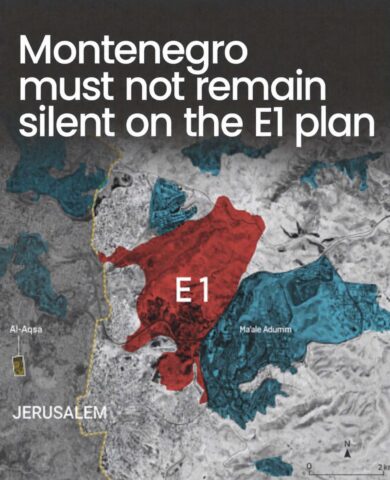
We call on the Government to clearly condemn Israel’s decision to issue tenders for the construction of more than 1,200 housing units in the E1 area of the occupied West Bank and to join the EU and other countries in calling for their withdrawal.
Montenegro’s hesitation, while the European Union and a growing number of European and other countries are calling for the withdrawal of the E1 plan, raises questions about the consistency of Montenegro’s foreign policy. We expect Montenegro to advocate for the urgent implementation of the two-state solution and to condemn both the E1 plan and any further ethnic cleansing and seizure of Palestinian territory. This project, together with other violent actions by Israel, threatens the survival of Palestine and peace in the Middle East, making Montenegro’s passive stance unacceptable. Montenegro, which bases its foreign policy on alignment with the EU and, declaratively, on respect for international law, has made no public statement on the E1 plan, although numerous European and other countries have done so.
For a small country whose international influence is not based on military or economic power, a reputation as a principled, consistent and reliable state represents one of the few genuine instruments of influence at its disposal. Montenegro must therefore take a clear position on serious violations of international and humanitarian law in the territory of the State of Palestine, particularly at a time when such violations are intensifying.
The latest escalation came with the continued implementation of the E1 plan. The area covers approximately 12 km² northeast of East Jerusalem. The planned construction would further jeopardise the territorial contiguity between the northern and southern parts of the West Bank and the connection between East Jerusalem and the rest of the State of Palestine, seriously undermining the possibility of achieving a two-state solution. The plan also threatens Bedouin communities in the area, including Khan al-Ahmar, which face the risk of displacement.
A joint statement by leaders on 20 August, describing these tenders as unacceptable, was initially signed by seven countries – the United Kingdom, France, Germany, Italy, the Netherlands, Canada and Norway. The following day, Australia, New Zealand, Sweden, Belgium, Austria and Spain joined the statement, followed by the European Commission and Greece, Cyprus on 22 August, Finland, Iceland and Lithuania on 24 August, and Malta and Denmark on 25 August. In just four days, the number of signatories grew severalfold – to 20 countries and the European Commission. Montenegro, however, is not among them.
The joint statement recalls that international law is clear and that Israeli settlements in the occupied West Bank are illegal, a position of the international community also affirmed by relevant United Nations Security Council resolutions. It specifically warns that this decision comes at a time of intensified settler violence against Palestinian civilians and severe restrictions on the Palestinian economy.
EU High Representative Kaja Kallascalled on 23 August for the tenders to be withdrawn and the E1 plans, as well as other settlement expansion projects, to be halted. The High Representative also addressed the same plan on 14 August last year, issuing an almost identical warning. This was followed by reactions from the EEAS in January and a joint statement in May this year, which had already warned companies against participating in the tenders. This is therefore not a sudden development to which Montenegro has simply not had time to respond. The E1 plan has been the subject of clear EU warnings for months and has meanwhile progressed from an announcement to an open tender with a deadline for the submission of bids. Despite this, there has been no response to the E1 plan in the publicly available statements of Montenegro’s Ministry of Foreign Affairs.
Montenegro has for years maintained almost complete alignment with the EU’s Common Foreign and Security Policy (CFSP), which the European Parliament regularly recognises as an important indicator of its commitment to the European path. In July this year, the Government of Montenegro adopted the Foreign Policy Strategy 2026–2029, based on alignment with the Constitution, international treaties and the EU accession process. The Strategy explicitly reaffirms Montenegro’s commitment to an international order based on international law. Remaining silent in a situation in which these principles are being gravely violated, while ethnic cleansing is taking place before the eyes of the entire world, calls these declared commitments into question, as they are not being followed by action.
In its advisory opinion of 19 July 2024, the International Court of Justice found that Israel’s continued presence in the occupied Palestinian territory is unlawful and that Israel must immediately cease all new settlement activity. The Court also pointed to the obligations of other states not to recognise as lawful the situation arising from that presence, nor to render aid or assistance in maintaining it. This obligation also applies to Montenegro.
We recall that, on 3 April 2026, non-governmental organisations and civic activists sent a letter to Prime Minister Milojko Spajić, Minister of Defence Dragan Krapović and Minister of Foreign Affairs Ervin Ibrahimović, demanding that the public be urgently informed of any export, import or trade in arms and military equipment with Israel, as well as the publication of all valid contracts, agreements and licences in this area. At the time, they also pointed to the obligation of Montenegro’s institutions to act transparently, responsibly and in a principled manner on issues that may have serious implications for compliance with international law. To date, the public has received no official information on these matters.
Montenegro cannot credibly insist on international law when it protects its own interests while remaining silent when the same principles are violated elsewhere. A principled foreign policy means applying the same standards regardless of who violates international law or how much political power they wield.
We therefore call on the Government of Montenegro and the Ministry of Foreign Affairs to break their silence on the E1 plan and clearly demand an end to the forced displacement of the Palestinian population, the illegal expansion of settlements and attempts to permanently alter the status of the State of Palestine. If international law is truly one of the foundations of Montenegro’s foreign policy, it must translate into concrete political positions rather than remain merely a formulation in strategic documents.
Centre for Civic Education (CCE)
Human Rights Action (HRA)
Dina Bajramspahić, civic activist
NGO Kuća
NGO Prima
Juventas
Centre for Democracy and Human Rights (CEDEM)
Women’s Action
Civic Initiative 21 May
Montenegrin PEN Centre
Spektra Association
Montenegrin LGBTIQ Association Queer Montenegro
Association “Štrpci – Against Oblivion”
Society for Cultural Development “Bauo”
NGO Municipal Multiple Sclerosis Association Bijelo Polje
Montenegrin Women’s Lobby
Antifascists of Cetinje
Women’s Rights Centre (WRC)
Centre for Investigative Journalism of Montenegro (CIN-CG)
Active Zone
NGO Ipso Facto
Association of LBTQ Women Stana
Open Centre Bona Fide
NGO Husein Paša – Pljevlja
NGO Ul-Info
Fund for Progressive Policies
NGO Mogul
NGO Ikre Rožaje
NGO Ecological Centre DELFIN
Centre for Development of Non-Governmental Organisations (CRNVO)
NGO Multimedijal
NGO Montenegrin Society of Philologists
Local Democracy Agency Nikšić – LDA
Women’s Safe House
Jovana Marović, civic activist
Dušan Pajović, civic activist
Džemal Perović, civic activist
Zenepa Lika, civic activist
Boško Milović, civic activist
Nikoleta Đukanović, civic activist
Milena Bešić, civic activist
Danijel Kalezić, civic activist
Vuk Vučeraković, civic activist
Milica Kankaraš Berber, civic activist
Almedina Dodić, civic activist
Emir Pilav, civic activist
Paula Petričević, civic activist
Mato Kankaraš, civic activist
Dr. Emeritus Šerbo Rastoder, full member of CANU, BANU and DANU




 English