Tea Gorjanc-Prelević on a panel about dealing with the past ahead of the anniversary of the Srebrenica genocide
To mark the International Day of Reflection and Commemoration of the 1995 Genocide in Srebrenica, the Ministry of Foreign Affairs and the Office of the United Nations Resident Coordinator in Montenegro organized a panel discussion on dealing with the past as a prerequisite for lasting peace and reconciliation. The gathering was opened by Deputy Prime Minister and Minister of Foreign Affairs of Montenegro Ervin Ibrahimović and UN Resident Coordinator Karoline Tissot, with a minute of silence in honor of the victims.
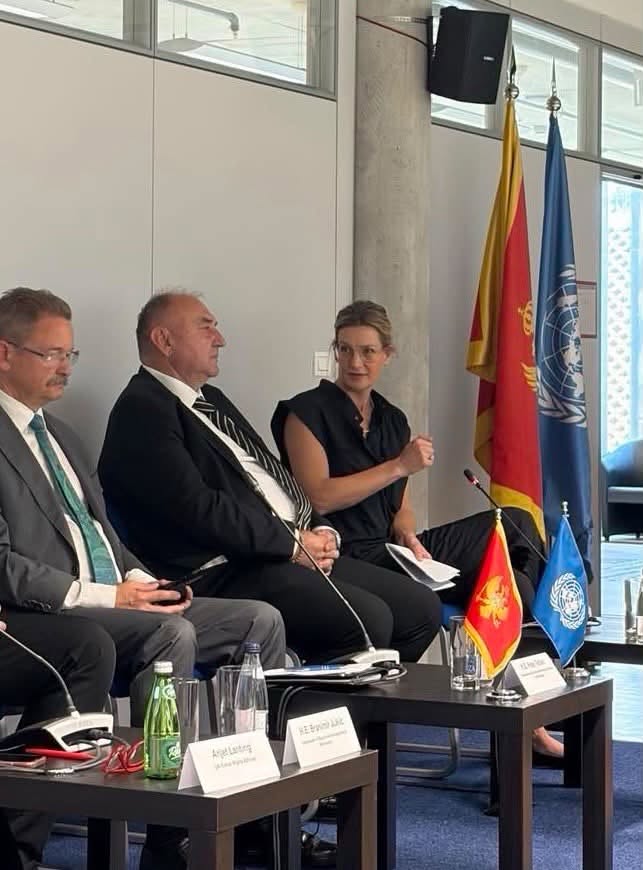
The panel, moderated by Anjet Lanting, Human Rights Adviser at the Office of the UN Resident Coordinator, featured BiH Ambassador Branimir Jukić, German Ambassador Peter Felten, Protector of Human Rights and Freedoms of Montenegro Siniša Bjeković, and HRA Executive Director Tea Gorjanc-Prelević.
Gorjanc-Prelević clearly pointed out that dealing with the past in Montenegro is blocked because genocide deniers and relativizers are part of the government. She recalled that the Resolution on the Srebrenica genocide was adopted in 2021, with opposition from the bloc that today forms the core of the ruling majority, and that the Speaker of Parliament still denies the genocide and disputes the verdict against Ratko Mladić — even though the crime against more than 8,000 men and boys has been judicially established and documented. She also asked whether official state representatives would attend the commemoration at Pobrežje, organized by NGOs, on 11 July, the International Day of Reflection and Commemoration of the Srebrenica Genocide.
In her assessment, memorialization in parliament is selective: since the change of government, two resolutions commemorating Serbian victims of genocide have been adopted without difficulty, including the one on Jasenovac, and a remembrance day for those victims has been established, while three proposed resolutions on documented crimes against Bosniaks are still waiting to be placed on the agenda. Referring to the Bosnian Book of the Dead by the Research and Documentation Center, she stated that Bosniaks account for around 80 percent of civilian victims of the war in BiH, which refutes the claim that everyone suffered equally in the so-called “civil war.” She warned that one fifth of citizens in Montenegro deny the Srebrenica genocide.
She pointed out that the lesson of Srebrenica warns the world not to look away from Palestine, recalling the decisions of the International Court of Justice and the International Criminal Court, which obliged all states to prevent genocide in Gaza. She warned that Montenegro, during Israel’s offensive on Gaza, approved arms exports to Israel — and that the Government has still not responded to the request of more than 50 non-governmental organizations for transparency and the suspension of that trade. She also addressed the issue to Ibrahimović, asking him to raise it with the Prime Minister and the Minister of Defence.
The event once again opened a question to which the state still has no answer, even five years after the decision of the Parliament of Montenegro: why 11 July has still not been officially established as a domestic Day of Remembrance for the victims of the Srebrenica genocide.
More details are available in Jelena Nelević’s article on the Pobjeda portal.







 English