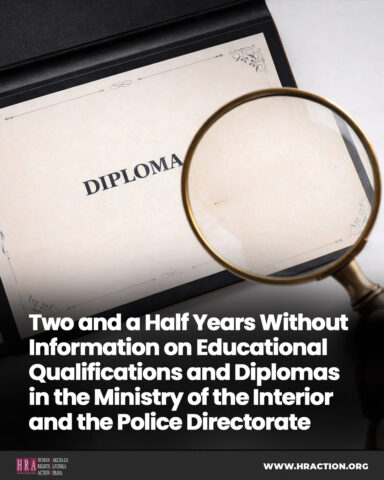
Two and a Half Years Without Information on Educational Qualifications and Diplomas in the Ministry of the Interior and the Police Directorate
For two and a half years, the Ministry of the Interior (MoI) has been denying Human Rights Action (HRA) access to data on the educational qualifications and diplomas of employees of the Ministry of the Interior and the Police Directorate.
On 2 October 2023, during the term of Minister Filip Adžić, HRA submitted a request for free access to information, seeking copies of parts of the personnel files relating to the level of educational attainment and educational qualifications (diplomas) of all civil servants and employees in the Ministry of the Interior, as well as all police inspectors and managerial staff in the Police Directorate.
The MoI under Adžić’s authority failed to issue a decision within the statutory deadline of 15 days. HRA therefore submitted a reminder and, on 22 November 2023, filed an appeal with the Agency for Personal Data Protection and Free Access to Information (the Agency) due to the administration’s failure to act. Although this was an urgent procedure, the Agency did not decide within the prescribed time limit, which led HRA to file a lawsuit with the Administrative Court of Montenegro on 12 February 2024.
On 6 November 2025, the Administrative Court upheld the lawsuit and ordered the Agency to decide on the appeal. In the meantime, the Agency had in fact acted: it upheld the appeal and ordered the MoI to decide on the request.
On 6 November 2025, the MoI — by then under Minister Danilo Šaranović — rejected the request, arguing that “providing copies of diplomas would entail the processing of personal data,” that this would require “the explicit consent of each employee in accordance with personal data protection regulations,” and that, given the number of employees (4,360), it could not comply with the request to the extent sought. The MoI did not cite a single specific legal provision to support such an interpretation.
Both grounds for refusal are unfounded.
Under Article 13 of the Personal Data Protection Act, the explicit consent of employees is required only for the processing of a special category of personal data — data relating to racial or ethnic origin, political opinions, religious or philosophical beliefs, trade union membership, health status, or sex life (Article 9). Such data are not contained in diplomas certifying educational qualifications, so this provision does not apply to the category of data requested.
Additionally, Article 14 of the Law on Free Access to Information provides for restrictions on access to information only for specific categories (personal data, classified data, security-related information, investigative information, internal consultations, business secrets, and tax secrecy), which do not include data on educational qualifications. Denying access to information on qualifications for carrying out work of public importance directly violates the principles of transparency and the public’s right to know (Articles 4 and 5 of the Law).
Invoking the “volume of work” because of the number of employees likewise does not constitute a legal basis for restricting the right of access to information. The Law on Free Access to Information does not provide for the possibility of denying access on the basis of an authority’s organizational or technical capacities.
HRA also has no objection to the MoI providing the information gradually rather than all at once — it could begin with officials holding the highest levels of responsibility and proceed from there. This removes any objection regarding the volume of work.
HRA again filed an appeal, which the Agency upheld on 5 March 2026, annulled the MoI’s decision, and returned the case for reconsideration, finding that the decision had been “adopted without legal basis” and that “the first-instance authority’s reliance on the argument that the delivery of copies of diplomas would entail the processing of personal data and therefore require the explicit consent of each employee was unfounded.”
The Agency emphasized that the MoI is indeed obliged to grant access to the information, after first redacting those parts of the personnel files to which access is justifiably restricted (such as personal identification numbers, home addresses, and bank account numbers) and that the MoI must issue a new decision within 20 days of receiving the Agency’s ruling.
HRA finds it troubling that information on the educational qualifications of persons responsible for protecting the citizens of Montenegro has been withheld for so long. Such conduct undermines trust in institutions and raises questions about the accountability of public officials.
Particular concern is caused by allegations that false diplomas are held not only by certain employees of the Ministry of the Interior, but also by members of parliament and senior state officials. We therefore call on the competent prosecutors’ offices to examine all such allegations without delay, and on the Ministry of the Interior finally to provide the requested data without further postponement.






 English