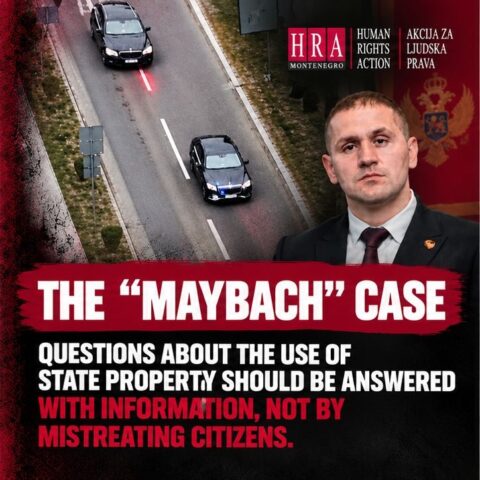
The “Maybach” case: disproportionate persecution of citizens over footage of an official car
Human Rights Action (HRA) protests against months of unnecessary harassment of citizens over footage of the official Maybach car used by the Director of the Police Administration.
Unjustified searches, questioning and the retention of citizens’ phones and a computer for months have disproportionately violated the freedom of expression and right to privacy of Saša Đilas, who used his mobile phone to film the car used by the Director of the Police Administration; Zorica Radulović, to whom he forwarded the footage; and her husband, Damir Baša. Such treatment is unacceptable in a democratic society and contrary to the obligation of the Police Administration and the Ministry of the Interior to ensure a basic level of transparency.
Through these actions, the police have sent a message that asking the authorities questions about the use of state-owned property is dangerous and can come at a high cost to citizens. A democratic society must not tolerate this message.
On 1 May 2026, the homes of these citizens were searched, including the homes of their family members. Đilas was questioned for hours. Their phones and a laptop were seized, and the court ordered a search of the entire contents of these devices. The phones were searched only after almost four months. Throughout that time, the citizens were not told what allegations they faced or whether they were considered suspects or witnesses. At the same time, the Police Administration indirectly linked them to organised crime and “hybrid activities” in publicly available statements. The proceedings ended yesterday with the conclusion that no criminal offence had been committed.
Footage of the car used by the police director, recorded in a public place, is not in itself evidence of an intention to threaten his safety. Photographing an official vehicle in a public place is not prohibited. Unauthorised photography constitutes an offence only when it significantly intrudes into someone’s private life (Article 174 of the Criminal Code of Montenegro). There was no such intrusion here, as the footage showed an official vehicle in a public space, without entering the private sphere of the police director’s life, for example by photographing his family or home. Before resorting to the most intrusive measures, the state should have presented concrete facts or credible indications that a real threat existed. It failed to do so.
The car that was filmed does not belong to the director, but to all citizens. They have the right to know how state property is used, on what basis it was assigned to the director, and what it looks like in real life. The authorities must respond to such questions by providing information, rather than through searches and the prolonged seizure of phones and computers.
The European Court of Human Rights has held that even the threat of criminal prosecution can have a chilling effect on freedom of expression when it causes a person to fear further state action and leads to self-censorship (Altuğ Taner Akçam v. Turkey). The Court also requires searches of homes, the seizure of computers and other electronic devices, and access to their contents to be justified by specific circumstances, proportionate to the aim of the investigation, and accompanied by effective safeguards against arbitrary and excessively broad interference with privacy (Smirnov v. Russia). Similarly, in Toth and Crișan v. Romania, the Court upheld the protection of expression by a private individual who had published a photograph of police officers taken on a public street while they were performing their official duties. The Court stressed that public officials acting in their official capacity are subject to wider limits of acceptable criticism than ordinary private individuals. It gave particular weight to the fact that the photograph had been taken on a public street, without covert methods, and published in connection with a matter of public interest.
HRA calls for:
All copies of the affected citizens’ data to be permanently destroyed, with written confirmation;
The State Prosecutor’s Office, the Department for Internal Control of the Police and the Council for Civilian Oversight of the Police to examine the lawfulness and proportionality of the measures taken, as well as the citizens’ allegations that their phones were not protected against unauthorised access;
The Police Administration to publicly disclose the facts on which it based its assessment that its director’s safety was under threat, and to apologise to the citizens it linked to crime;
The parliamentary Security and Defence Committee to examine this case and establish the basis on which the police director uses the official Maybach vehicle.









 English