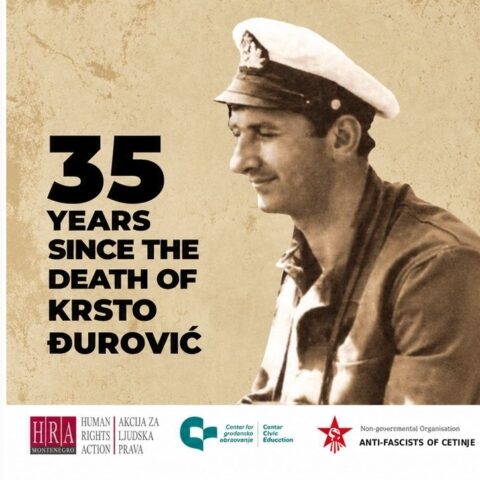
35 Years Since the Death of Rear Admiral Krsto Đurović: Establish the Truth About His Death and Preserve the Memory of Peacemakers
Tomorrow marks 35 years since the death of Krsto Đurović, a rear admiral in the Yugoslav People’s Army (JNA), who died in a helicopter crash under unexplained circumstances in 1991, during the first days of the JNA’s attack on the Dubrovnik hinterland in the Republic of Croatia.
“As long as I am in command, rest assured that not a single shell will fall on Dubrovnik,” Đurović told the then mayor of Dubrovnik, Petar Poljanić, in September 1991.
His opposition to the attack on Dubrovnik has ensured that he is remembered as an example of moral courage and humanity during the intense war propaganda that accompanied the attack.
“We should all rise and stand to attention whenever his name is mentioned,” Poljanić said of Đurović.
In May last year, councillors in the Assembly of the Old Royal Capital Cetinje adopted an initiative by the NGOs Human Rights Action (HRA), the Centre for Civic Education (CCE) and the Antifascists of Cetinje to name a street in the Pod Granicom neighbourhood after Rear Admiral Krsto Đurović. By the end of this year, the street will bear his name, preserving the memory of his anti-war stance and reminding future generations of their duty to oppose war.
In addition to honouring Đurović, this decision affirms the anti-war tradition of Cetinje, a city that symbolised resistance to war and violence during the difficult years of Yugoslavia’s disintegration. This tradition was also reflected in two large rallies held in Tito Square, now Palace Square, on 31 July 1991 and 1 February 1992, where people sang: “A fairy calls from Mount Lovćen: forgive us, Dubrovnik!”
It is particularly important to pass on the memory of the resistance to war that existed in Montenegro in the 1990s to younger generations, who currently have no opportunity to learn about it in school. We therefore call on other municipalities in Montenegro to follow Cetinje’s example and dedicate public spaces to people who had the awareness and courage to oppose wartime nationalist propaganda.
At the same time, even after 35 years, the circumstances of Rear Admiral Đurović’s death remain unresolved. In December last year, HRA informed the Special State Prosecutor’s Office of the information in its possession concerning this incident and requested an investigation into whether his death resulted from a war crime, which is not subject to a statute of limitations.
The passage of time does not diminish the obligation to establish the truth. We demand that the circumstances of Krsto Đurović’s death finally be clarified and that any responsibility for his death be established.






 English