Barović Chose Honour, Podgorica Is Still Choosing Whether to Remember Him
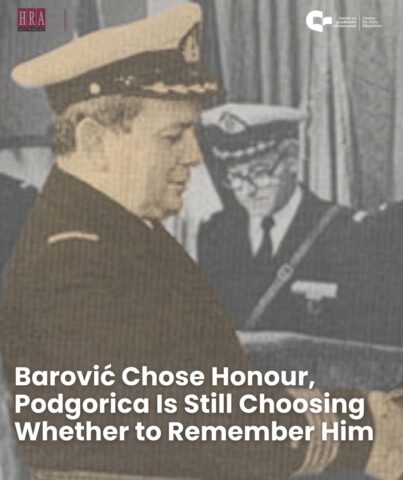
Centre for Civic Education (CCE) and Human Rights Action (HRA) recall that on this day 35 years ago, on 29 September 1991, Yugoslav People’s Army (JNA) Admiral Vladimir Barović took his own life rather than carry out an order from the JNA Supreme Command to shell Croatian coastal towns from the island of Vis. In his farewell letter, he wrote that he was doing so “because Montenegrins cannot destroy a people who have done them no wrong”. Following his death, the order was abandoned.
Exactly one year ago, CCE and HRA submitted an initiative to the Council for Naming Streets of the Capital City for a street in Podgorica to be named after Admiral Barović. In the meantime, we havereceived confirmation that the initiative meets the requirements to proceed to the next stage of the procedure. We expect the Council to decide on the initiative within a reasonable timeframe and not to postpone its decision until another anniversary. For comparison, it took the Old Royal Capital of Cetinje only seven months to act on an initiative submitted by HRA, CCE and the Antifascists of Cetinje in October 2024. In May 2025, it decided to name a street in the Pod Granicom neighbourhood after Rear Admiral Krsto Đurović, a Cetinje native who, like Barović, opposed the JNA attack on Dubrovnik.
Barović’s name has already found its place in public remembrance outside Montenegro. In 2022, a memorial plaque bearing a quotation from his farewell letter was unveiled on Vis, while in 2023 he was declared an honorary citizen of Pula. Montenegro posthumously decorated him in 2016, but there is still no memorial or public landmark in the country bearing his name.
In November 2025, Podgorica was awarded the title of European Youth Capital 2028, thereby assuming a responsibility to be a city that includes, educates and inspires young people. That title also entails responsibility for the values the city offers to new generations. A street named after Admiral Barović would make a concrete contribution to this, as it would serve as an everyday reminder to young people in Podgorica that honour and personal courage are not merely part of the past, but remain standards for their own time. We hope that the decision on naming the street will be adopted before 2028, so that the memory of Admiral Barović becomes part of the city that will welcome young people from across Europe that year.
Admiral Barović’s act is not mentioned in history textbooks either. We call on the Ministry of Education, Science and Innovation to contribute to ensuring that the story of Admiral Barović is included in teaching materials on the wars of the 1990s, as an example of personal choice and responsibility at a time when obedience was the easier path.
Remembering Barović is particularly important today, when crimes committed during the 1990s continue to be relativised in the region’s public sphere, while their perpetrators are portrayed as heroes. Barović’s example demonstrates that even among the senior ranks of the military that waged those wars, there were those who refused to take part in aggression.
Montenegro, as the country that has advanced furthest in the process of accession to the European Union, has an opportunity to demonstrate that a culture of remembrance can be built on honour and reconciliation rather than oblivion. A street named after Admiral Barović would serve as a lasting reminder that it is possible to refuse injustice even when the cost is the highest, but also as a clear message about how Montenegro today should view the wars of the 1990s.






 English