N18.T1 – Constitutional Court Cannot Rule on Constitutionality of UAE Agreement Without New Judges
HRA NEWSLETTER 18 – TOPIC 1
President Jakov Milatović nominated Jelena Ružičić as a judge of the Constitutional Court of Montenegro (CC) on 5 March. She is expected to replace Budimir Šćepanović, whose term ended back in June 2025.
At a press conference, Milatović said that the current Supreme Court judge has extensive experience. “Ružičić is a judge with 30 years of professional experience, 20 of which in the judiciary. Between 2013 and 2016 she also served at the court in Strasbourg. I believe it would be hard to find a comparable CV in the Montenegrin judiciary,” he said.
Milatović expects Ružičić to receive support from MPs of the former Democratic Front (New Serbian Democracy and Democratic People’s Party), Democratic Montenegro, and the Socialist People’s Party, given that they had already voted for her in 2022, when she was the Constitutional Committee’s candidate for Constitutional Court judge. At that time she received 41 votes in plenary session, which was not enough for election. MPs of the Bosniak Party voted against her, while the DPS, SDP and SD did not take part in the vote.
Milatović also expects his second nominee, Predrag Krstonijević, a judge of the Higher Court in Podgorica, to secure enough votes in Parliament.“Any delay by the Assembly in electing them, without clear justification, is an attack on the rule of law in Montenegro… It is an attack by political factions within the Assembly,” Milatović said.
It should be recalled that the president’s earlier nominees — attorney Mirjana Vučinić and judge Krstonijević — did not obtain the required parliamentary support. Vučinić failed to be elected even after a second vote, while a repeat vote for Predrag Krstonijević — who is to replace Desanka Lopičić — has been awaited since mid-February. In the second round, he needs the support of three-fifths of MPs, i.e. 49 votes.
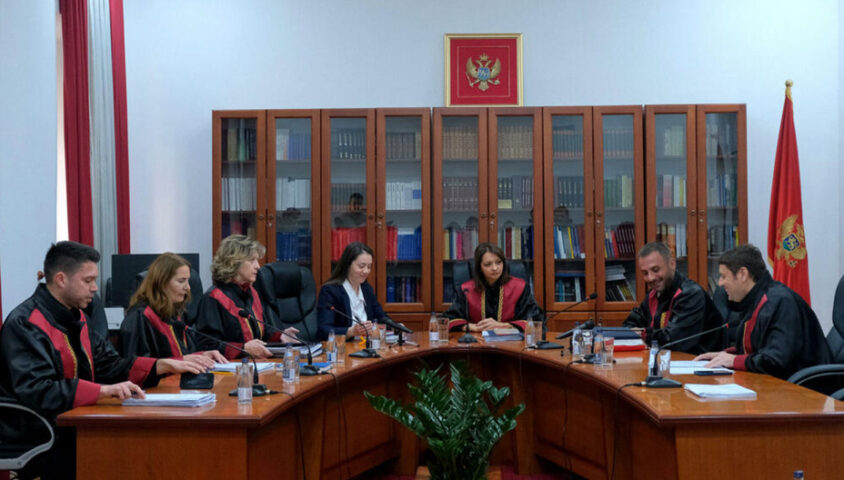
The Constitutional Court, which is required to have seven judges, is currently not at full complement, being one judge short. As a result, it is in some cases unable to reach a decision.
That is precisely what happened in mid-March (16 March), during an attempt to initiate proceedings to review the constitutionality of the Law on Ratification of the Agreement on Cooperation in the Field of Tourism and Real Estate Development, concluded between the governments of Montenegro and the United Arab Emirates. The vote on initiating proceedings ended 3:3, meaning the rapporteur judge’s proposal did not receive the required majority of four votes.
The Government of Montenegro triumphantly announced the same day that the Constitutional Court vote had demonstrated that the UAE Agreement was in compliance with the Constitution. “Since the Constitutional Court did not find any inconsistency with the Constitution, the interstate agreement remains an integral part of the legal system,” the executive stated.
However, the Constitutional Court issued a rebuttal the following day, denying that any decision had been reached as to whether the disputed document was constitutional or not.
“Any representation of such a vote as a confirmation of constitutionality is not grounded in fact and prejudges the outcome of this case… The matter will be reconsidered following the election of the missing judges, or earlier should any of the judges change their position,” the Constitutional Court stated, emphasising that only a full bench guarantees that a decision will be reached in all cases.
Human Rights Action appealed to the Parliament of Montenegro to urgently elect both of President Jakov Milatović’s nominees to the Constitutional Court, stressing that this is the only way the court can function effectively.
“Not a single MP has publicly raised any objection to these candidates, nor are we aware of any reason why they should not be appointed to these positions.”
HRA also noted that Constitutional Court judge Desanka Lopičić continues to adjudicate despite the fact that “her term should have ended, as she has met both conditions for retirement.”
“Were Lopičić a judge of any ordinary court in the country, she would not be permitted to sit,” they stressed.









 English