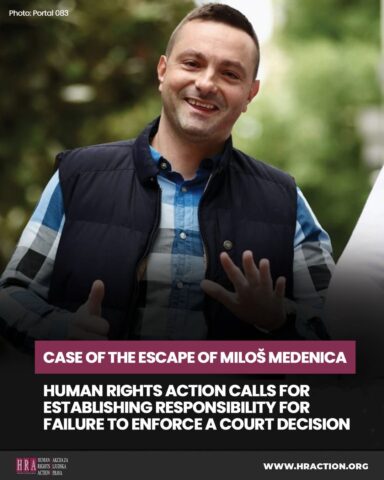
CASE OF THE ESCAPE OF MILOŠ MEDENICA – HUMAN RIGHTS ACTION CALLS FOR ESTABLISHING RESPONSIBILITY FOR FAILURE TO ENFORCE A COURT DECISION
Human Rights Action (HRA) expresses serious concern regarding the failure of the Police Administration to prevent the escape of Miloš Medenica, despite a court-imposed supervision measure prohibiting him from leaving his residence, the enforcement of which falls within the competence of the police. It is essential that the State Prosecutor’s Office and the Internal Control Department of the Police urgently determine responsibility for the non-enforcement of the court decision, including any facilitation of, or assistance in, the escape of a convicted person.
Pursuant to the Criminal Procedure Code, the supervision measure prohibiting a person from leaving his or her residence is enforced by the police (Article 168(2)). The Police Administration is obliged to ensure the effective, continuous and efficient implementation of this measure and to take all necessary steps to prevent its breach. Article 18 of the Law on Internal Affairs provides that the police are duty-bound to act preventively in order to prevent unlawful conduct, while Article 19 stipulates that police powers must be exercised in a manner that achieves the lawful objective with the least harmful consequences. The Criminal Code further classifies the refusal of an official to enforce a final and enforceable court decision as a criminal offence (Article 395).
In the case of Miloš Medenica, it is evident that both preventive action and effective enforcement of the supervision measure were lacking. The fact that he was able to leave the premises where he was required to remain and evade supervision without a timely police response constitutes a serious omission that must be examined, including in the context of potential facilitation of escape.
That omission cannot be justified by the mere formal notification of the court regarding the breach of the measure, as such notification does not relieve the police of their obligation to ensure its effective enforcement.
Pursuant to Article 94 of the Law on Internal Affairs, the police are authorised to use means of coercion where an official duty cannot be carried out by warning or order alone. In the present case, the official duty in question was precisely to ensure the enforcement of the measure prohibiting the leaving of a residence.
Any contrary interpretation would relativise the binding nature of the court order imposing the prohibition on leaving the residence in the specific case.
The measure prohibiting a person from leaving his or her residence constitutes a specific supervision measure which, in substance, amounts to deprivation of liberty under house arrest conditions, within the meaning of Article 51 of the Criminal Code of Montenegro and the case-law of the European Court of Human Rights (Mancini v. Italy, no. 44955/98; Lavents v. Latvia, no. 58442/00; Delijorgji v. Albania, no. 6858/11).
This means that the person to whom the measure applies is already deprived of liberty, and that the police are therefore not required to “deprive the person of liberty again,” but rather to ensure the continuity of enforcement of the existing measure and to secure the person’s continued confinement in the residence where it is being executed.
A contrary interpretation, publicly expressed by the Director of the Police Administration — namely, that the police have no further obligation to act once a breach of the measure has been established — raises serious concerns. Such an interpretation is incompatible with the obligation to enforce court decisions and may give rise to criminal liability under Article 395 of the Criminal Code of Montenegro. It also undermines the purpose of supervision measures and risks encouraging their systematic violation. Previous practice demonstrates that police officers have taken action against individuals found in breach of such measures, including notifying the competent court and undertaking appropriate procedural steps.
Given the seriousness of the failures in the supervision of Miloš Medenica, HRA expects the State Prosecutor’s Office to conduct an urgent, thorough and impartial investigation into the circumstances of his escape, including the possible commission of criminal offences relating to the failure to enforce court decisions and negligent performance of official duties. Furthermore, the Internal Control Department must urgently examine the actions of the responsible police officers and their superiors and determine accountability for serious disciplinary violations — including failure to execute official duties or negligent, untimely or careless performance thereof (Article 95(1)(1) of the Law on State Officials and Employees). In any event, the public must be informed of the outcome of the investigative process in order to strengthen trust in police oversight mechanisms.
The absence of accountability in such cases undermines the rule of law and public confidence in institutions, sending a message of tolerance of impunity and institutional weakness in addressing serious crime.








 English