MORE EFFECTIVE HANDLING OF TORTURE AND GENDER-BASED VIOLENCE CASES IS CRUCIAL FOR EU ACCESSION
Progress achieved in prosecuting cases of torture and gender-based violence, but institutions still have work to do, reports by Human Rights Action and the Women’s Rights Center show.
From 2022 to 2025, a total of 268 cases were opened against at least 424 individuals for abuse allegedly committed by state officials. An indictment was filed in every fifth case, half of the complaints were dismissed, and nearly one third of the cases remained unresolved, according to the HRA report Effectiveness of Investigations into Ill-treatment in Montenegro 2022–2025.
One of the report’s authors, Bojana Malović (HRA), pointed out that most complaints in the analysed period concerned the criminal offence of ill-treatment – 140 cases, followed by torture with 23 cases, and coercion of confession with 18 complaints. The data for the past year is particularly concerning.
“The data shows that reports of the most serious forms of ill-treatment – torture and coercion of confession – are not decreasing, but increasing. Specifically, in 2025, the State Prosecutor’s Office received the highest number of complaints for ill-treatment, torture, and coercion of confession (75) in the past four years, four times more than in 2022 (19),” Malović said.
On the other hand, the binding instruction issued by the Supreme State Prosecutor to prosecutors in May 2024 has contributed to increased efficiency in prosecution. As a result, the indictment rate rose from 9.2% in 2023 to 27–32% in 2024–2025.
However, it was observed that in cases that have lasted unjustifiably long, the obligation of supervisors to issue binding instructions has not been consistently respected.
“Audiovisual recording of interrogations was not applied, and suspect identification procedures were used very rarely.”
Jovan Bojović, also an author of the report, stated that monitoring results highlighted key challenges in prosecuting police abuse cases.
“These stem from insufficient institutional coordination, ineffective execution of court orders—primarily by the police—as well as insufficient prosecutorial activity during proceedings and delays in decision-making on procedural matters.”
Montenegro must protect human rights not only through legislation but also in practice, and ensure a prompt and adequate judicial response to ill-treatment, in line with the recommendations of the European Committee for the Prevention of Torture (CPT), said Tea Gorjanc-Prelević, Executive Director of Human Rights Action.
“However, these recommendations have not been fulfilled, as confirmed by the recently leaked preliminary findings of the CPT’s third visit to Montenegro in the past five years. It is particularly concerning that these findings, as well as the Government’s response, have been withheld from the public. We believe that the European path requires full transparency and the decisive implementation of CPT recommendations to the greatest extent possible, already this year,” Gorjanc-Prelević stated.
Shortcomings also identified in handling gender-based violence cases
The NGO Women’s Rights Center monitored 41 criminal proceedings involving women as victims/injured parties—26 in Podgorica and 15 in Nikšić—across a total of 182 hearings. The monitoring of court proceedings was carried out from October 2024 to October 2025.
The report on monitoring court proceedings in domestic violence cases, presented by its author Ana Jaredić, shows progress in the judiciary’s approach to victims’ rights. However, better information for victims about the course of proceedings and access to free legal aid is still lacking, and most victims did not have legal representation during the proceedings.
Additionally, in a significant number of convictions (42%), security measures were not imposed, even though the risk of repeated violence was identified in many cases. Among the imposed measures, restraining orders were the most common, while other measures were used less frequently and inconsistently, and the combined use of measures is not an established practice. The measure of eviction from the apartment was imposed only once.
“Monitoring indicates that access to legal support is limited and that victims’ procedural rights are often exercised without professional assistance. When a legal representative was present, they were most often engaged at the initiative of the injured party herself, while the use of the free legal aid system was recorded in a smaller number of cases, pointing to insufficient visibility or accessibility of this mechanism in practice,” the report states.
The Executive Director of the Women’s Rights Center, Maja Raičević, said that the fight against violence is a long-term process in which it is crucial that all actors work in the same direction.
“The fight against violence is not only a matter of individual protection, but a matter of justice, safety, and genuine commitment to the rule of law,” Raičević said.
Preventing torture crucial for EU accession, joint institutional action necessary
HRA Executive Director emphasized that the prohibition of ill-treatment is a fundamental value of a democratic society, which Montenegro must demonstrate in its EU accession process.
“However, that proof is still lacking. Given the unfortunate history of uninvestigated and unpunished cases of torture, including those documented in Zlatarska Street, the case of Milorad Martinović, and the SKY communications, public trust in the rule of law has been seriously undermined. The impression of tolerance or even institutional complicity is still present. Although certain progress can be observed, it is not yet sufficient,” Gorjanc-Prelević concluded.
The European Union Ambassador to Montenegro, Johann Sattler, reminded participants of the obligations Montenegro faces on the path to closing Chapter 23.
“One of the closing benchmarks for this chapter is the implementation of the recommendations of the European Committee for the Prevention of Torture and Inhuman or Degrading Treatment or Punishment (CPT), as well as prompt judicial proceedings in cases of ill-treatment. Without tangible progress in this area, Chapter 23 cannot be closed. Moreover, this is of crucial importance for Montenegrin society as a whole,” Sattler said.
He also stressed the importance of independent institutions.
“Access to justice requires independent courts and timely proceedings—because delayed justice is denied justice,” the EU’s highest representative in Montenegro stated.
President of the Constitutional Court Snežana Armenko recalled that the Court had, for years, dealt with the effectiveness of state authorities in torture-related cases, such as the Zlatarska Street case, the beating of Milorad Martinović, and the Milić and Nikezić case, which also received judgments before the European Court of Human Rights (ECtHR).
“Our contribution was to emphasize and establish the standard that it is not enough to secure a conviction, but that penal policy must also be such as to deter such conduct—especially by those responsible for protecting persons under their control, away from public scrutiny,” Armenko said.
She added that appeals concerning alleged violations of the prohibition of torture would always be a priority for the Constitutional Court, but that prompt and efficient resolution of such cases is not possible without state investment and the adoption of a new Law on the Constitutional Court.
“This is a year in which the state must invest in the capacities of judicial institutions to prevent similar situations in the future, and in that regard we encourage you to continue monitoring the work of courts, prosecutors, and the police,” Armenko told representatives of HRA and the Women’s Rights Center.
Supreme State Prosecutor Milorad Marković also praised the reports of Human Rights Action and the Women’s Rights Center and emphasized the importance of addressing torture cases for the prosecution service.
“Every allegation of ill-treatment, especially when committed by state officials or when the victims are persons in a vulnerable position, represents a serious test for the State Prosecutor’s Office, as well as for the entire judicial system,” Marković said.
He stressed that joint action is necessary.
“The fight against torture and gender-based violence must be a shared responsibility of all institutions. Only through coordinated action by the prosecution, courts, police, and organizations supporting victims can we further improve the progress already achieved and ensure that it is long-term and sustainable,” he said.
He emphasized that although notable results have been achieved, continued improvement is needed through training, specialization, and continuous monitoring of performance.
Ombudsman Siniša Bjeković pointed to the state’s obligation to combat all forms of torture, domestic violence, and violence against women, and stressed that Montenegro cannot apply double standards when it comes to human rights and freedoms.
“This is a matter of institutions that must act equally responsibly and efficiently, in a way that recognizes not only the position of the accused and the authorities conducting proceedings, but also the position of those harmed by criminal acts.”
Without a decisive fight, Bjeković said, there can be no progress in EU integration.
“Without a clear and vocal fight against torture, without effective investigations, and without appropriate court decisions that have a deterrent effect, there can be no progress.”
Anjet Lanting, UN Human Rights Adviser in Montenegro, shared that the Government of Montenegro is expected to submit its next report to the UN Committee Against Torture by May 13. She also noted that the UN Special Rapporteur has requested to visit Montenegro in late 2026, and that Government has responded positively to the request.
Audiovisual hearings to be introduced in more prosecutor’s offices in the future
Currently, audiovisual equipment can be used in only four prosecutor’s offices in Montenegro, said Ana Radović, State Prosecutor at the Higher State Prosecutor’s Office in Podgorica. She believes that the use of such equipment would improve the position of victims of gender-based violence.
“If more victims were heard using audiovisual technology, I am confident that courts would accept proposals not to summon victims to the main hearing and question them again. However, only four out of the 15 prosecutor’s offices in Montenegro that are competent to handle these criminal offences have functional audiovisual equipment.”
The lack of such equipment poses a challenge for prosecutors, said Danka Ivanović-Đerić, State Prosecutor at the Higher State Prosecutor’s Office in Podgorica, announcing upcoming investments by the Supreme State Prosecutor’s Office.
“In the coming period, the Supreme State Prosecutor’s Office will equip additional prosecutor’s offices with technical equipment, and we will further strengthen awareness of the importance of this type of hearing, especially for victims,” Ivanović-Đerić said.
Deputy Ombudsman Mirjana Radović emphasized that strengthening the prosecution service is essential.
“I believe we are on the right track to ensure that the evidence presented by the prosecution before the courts is of a higher quality,” she said.
Mutual criticism among key actors in the process
The President of the Basic Court in Nikšić, Sanja Nikić, stated that in gender-based violence cases, a protocol should be developed for doctors to follow in order to ensure more precise medical examinations of victims.
The Acting President of the Basic Court in Cetinje, Tanja Vidić, noted that prosecutors often shift responsibility onto the courts.
“A lot of responsibility is shifted to the court, so facts that were not established during the prosecutorial investigation are determined during the main hearing.”
“If an effective, prompt, and thorough investigation has been conducted, then the trial itself is much easier,” said the President of the Basic Court in Podgorica, Željka Jovović, pointing to the need for specialization of judges and prosecutors.
According to Sanja Nikić, the judiciary also lacks a more supportive social environment. This can be achieved through a strong, coordinated system in which all actors are connected and politicians fulfill their responsibilities.
“To create conditions appropriate for the work we do… and to ensure that the overall social climate at least approximately reflects the importance of our work,” she said.
Judicial Council member and Basic Court judge in Podgorica, Rade Ćetković, said he was pleased that the HRA and Women’s Rights Center reports recognized the conditions in which judges work, such as the lack of administrative and technical resources, but added:
“In my opinion, the system must not rely on the enthusiasm of judicial office holders. Instead, it must demonstrate its strength through the strength of the institution itself, which must have all the necessary resources to combat domestic violence effectively,” Ćetković said.
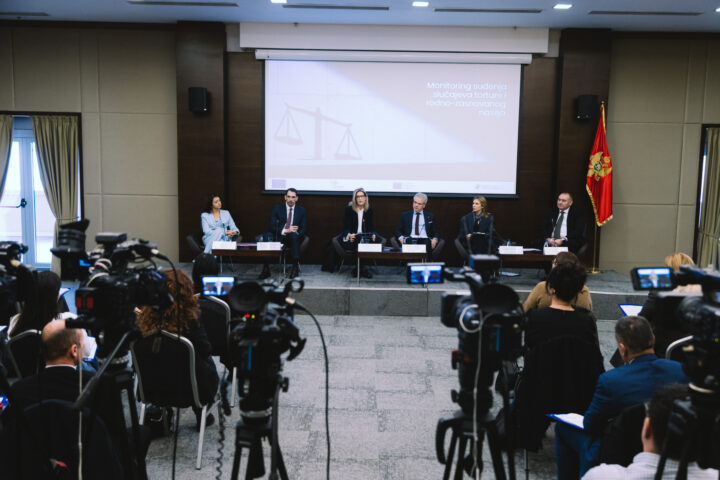
At the panel organized by HRA and the Women’s Rights Center, it was also emphasized that, in addition to easier access to free legal aid, victims of gender-based violence must be provided with timely psychological support.









 English