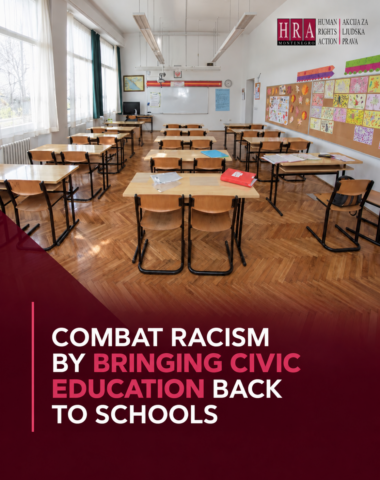
COMBAT RACISM BY BRINGING CIVIC EDUCATION BACK TO SCHOOLS
Human Rights Action condemns the racist harassment of a tourist on a bus travelling from Kotor to Perast. We commend her response, the response of citizens on social media who reported the incident to the police, and the very efficient reaction of the police, who identified and prosecuted those involved within 24 hours. It is alarming that open intolerance and violence towards a person of Asian descent was shown by children aged 14 to 16, and that none of the adults nearby tried to stop such behaviour.
The incident has shown how easily a single local act of boorishness can now become known worldwide and harm an entire country. The post by the tourist, Megan, who said she had not had such an unpleasant experience in any of the 46 countries she has travelled to, was viewed by more than 320,000 people in a short time. More than 8,000 people, for example, endorsed one of the comments under the post: “I’m from Europe, but I will never visit Montenegro after seeing this.”
Clearly, children should be raised to be citizens of the world, not just of their own street. The state has a duty to do its part towards that goal.
We call on the Ministry of Education, Science and Innovation to finally begin introducing compulsory civic education in primary and secondary schools. The state must provide a professional, targeted and systemic response to the prejudices that children in Montenegro grow up with. They are not born with these prejudices; they acquire them in a society where discriminatory stereotypes are normalised and where there is no adequate human rights education in schools.
We recall that a 2025 survey by Forum MNE warned of a worrying social distance among young people towards those they perceive as different: almost a quarter of the pupils surveyed expressed distance towards people of a different religion or nationality. The survey also found that children accept violence as a way of solving problems, that there is insufficient empathy, and that dialogue and compromise are rejected. This should have been the alarm bell for urgent and concrete measures in schools.
As early as November 2023, Human Rights Action (HRA), the Centre for Civic Education (CCE) and ANIMA demanded that civic education be restored as a compulsory subject, a status it lost in 2017. In February 2024, at the panel discussion “Children’s Right to Human Rights Education in Montenegro”, we discussed this with the Minister of Education, Science and Innovation, Anđela Jakšić Stojanović, who supported our initiative at the time. Since then, the Education Reform Strategy 2025–2035 has been adopted. It recognises the importance of civic education but does not provide for restoring it as a compulsory subject.
We call on the Ministry of Education, Science and Innovation to set and publish a plan and timeline for introducing compulsory civic education in schools. This must be accompanied by appropriate training for the teachers who will teach it, and by a curriculum that enables pupils to recognise racism, discrimination and hate speech in practice, to understand why they are wrong, and to feel what they are like from the other side.
This case is no basis for collectively labelling the children and citizens of Montenegro. However, in light of Forum MNE’s findings, it must not be dismissed as an isolated incident. The state has a duty to seriously address the causes of such behaviour and to ensure that all children learn to respect human rights.
Condemning incidents after the fact is necessary, but education that helps prevent violence should not be withheld any longer.




 English