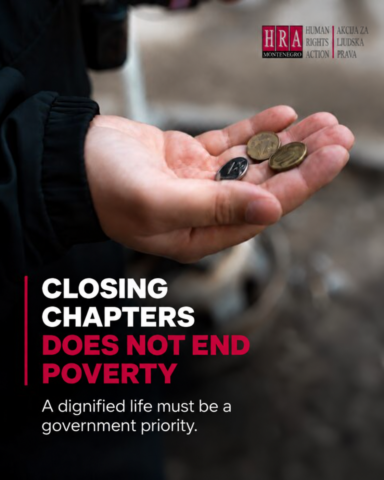
Closing Chapters Does Not End Poverty – A Dignified Life Must Be A Government Priority
On the occasion of the International Day for the Eradication of Poverty, 17 October, Human Rights Action (HRA) calls on the Government and Parliament to ensure that the 2027 budget provides effective support to people who lack the basic resources needed for food, housing, medical treatment and other necessities. A dignified life is a right, and ensuring that right is the responsibility of the state.
On 12 October, Montenegro provisionally closed negotiating Chapters 18 (Statistics) and 19 (Social Policy and Employment). While we welcome this progress, we demand that its results be reflected in the lives of the most vulnerable people. Closing chapters does not put food on the table, pay electricity bills or provide a roof over people’s heads. The Government must demonstrate how reforms contribute to reducing poverty.
The preliminary results of MONSTAT’s 2025 Survey on Income and Living Conditions, published in July 2026, reveal the serious scale of the problem: the at-risk-of-poverty rate stood at 20.9%, an increase of 0.9 percentage points compared with the previous year. These figures indicate that approximately one in five people in Montenegro was at risk of poverty.
Rising living costs further worsen the situation of the most vulnerable, while state support remains far below families’ needs. Data from the Centre for Education, Information and Trade Union Research show that the trade union consumer basket for a four-person household amounted to €2,170 in the third quarter of 2026. Although this basket is not an official poverty threshold, comparing it with benefit amounts reveals a substantial gap: a four-person family with no income, with two children each receiving €30 per month, receives just €232.41 – €172.41 in social assistance and €60 in child benefits. This amounts to only 10.7% of the value of the consumer basket, while a full year of benefits would not cover even two monthly baskets. The state must not leave families to choose between food, medicines and paying their bills.
The Strategy for the Development of the Social and Child Protection System 2025–2028 recognises the need for more adequate benefits and more accessible services. The Government should present the results: who has gained access to assistance, and how many people have been lifted out of poverty through the measures taken. Assistance must also be accessible to those who, because of illness, disability, lack of documents or other barriers, cannot navigate administrative procedures on their own.
Children with autism and other children who need additional support, together with their families, deserve significantly greater support from the state. We call on the Government to ensure accessible health, education and social services, as well as support that enables parents to work. A child’s development and inclusion in the community must not depend on their parents’ financial means.
We specifically call for organised support for homeless people and those without adequate housing: safe temporary accommodation, food, health care and social protection, as well as long-term housing solutions. No one should have to live in conditions that violate human dignity.
As far back as 2014, the UN Committee on Economic, Social and Cultural Rights recommended that Montenegro allocate sufficient resources to combat poverty, particularly in the north, monitor the results of its measures, and improve data collection and housing support for homeless people and low-income families. Twelve years later, we demand the publication of a review of the implementation of these recommendations, with clear deadlines and responsibility for the outstanding obligations.
We call on the Government and Parliament, through the 2027 budget and accompanying measures, to:
increase social benefits in line with recipients’ basic needs and remove barriers to accessing assistance;
ensure accessible services and housing support, including accommodation for homeless people;
protect children from the consequences of poverty through support for nutrition, education and health care, with dedicated funding for services for children with autism and support for their families;
set measurable poverty reduction targets, with clear deadlines, responsible institutions and public reporting;
involve people living in poverty in designing measures that directly affect them.
The budget reflects whose needs those in power consider a priority. European standards must become an everyday reality for Montenegro’s most vulnerable people as well. The right to a dignified life must not be a privilege; it is a universal right to which everyone is entitled.



 English