STATUTE OF LIMITATIONS IN THE ZLATARSKA STREET ABUSE CASE: INSTITUTIONAL FAILURE AND A SERIOUS ISSUE AHEAD OF EU ACCESSION
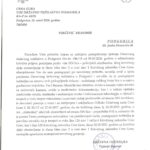
On 9 February 2026, the Basic State Prosecutor’s Office in Podgorica dismissed the criminal complaint in the so-called Zlatarska Street case, concerning police abuse of lawyer Branimir Vukčević and Canadian national Momčilo Baranin on 24 October 2015, on the grounds that the prosecution had become time-barred already in 2021.
Human Rights Action (HRA) stresses that this decision amounts to a declaration of the systemic failure of the Montenegrin State Prosecutor’s Office to secure punishment for evident police torture, which the entire world was able to witness thanks to footage recorded by a Vijesti journalist.
The decision on the statute of limitations comes after both the Constitutional Court of Montenegro and the European Court of Human Rights found that the State Prosecutor’s Office had not conducted the investigation in accordance with international standards.
The injured party, Branimir Vukčević, will file a complaint against this decision with the Higher State Prosecutor’s Office in Podgorica, requesting that the offence be legally classified as torture, i.e. unlawful punishment, which would extend the limitation period until 2035.
On 24 October 2015, at around 22:30, in central Podgorica, in Miljana Vukova Street (the so-called Zlatarska Street), Baranin and Vukčević were beaten by police officers. This occurred after police dispersed protests organised by the Democratic Front.
Citizens Baranin and Vukčević did not participate in any unrest, did not resist, were not deprived of liberty, and no misdemeanour or criminal proceedings were ever initiated against them.
Police officers forced them to lie on the pavement, beat them, insulted and swore at them, kicked them, and then, after inflicting bodily injuries (later confirmed by medical documentation), left them lying in the street without providing assistance.
Despite the seriousness of the allegations and the evidence, the police officers who committed the abuse have not been identified to this day, more than ten years after the event. The case remained in the preliminary inquiry phase for an entire decade, only for the criminal complaint to be finally dismissed — not for lack of evidence, but due to the statute of limitations caused by the inaction of the competent authorities.
It is also scandalous that the Basic State Prosecutor’s Office in Podgorica kept the case open for more than four years after the date on which it now claims the prosecution became time-barred. In any event, the last procedural step in the case was taken in 2021, after the European Court of Human Rights delivered its judgment in Baranin and Vukčević v. Montenegro, finding a violation of Article 3 of the European Convention on Human Rights.
As early as 22 January 2017, HRA lodged constitutional complaints on behalf of Baranin and Vukčević. On 21 June 2017, the Constitutional Court of Montenegro unanimously found a violation of the constitutional prohibition of torture due to the ineffective investigation of police abuse — for the first time in its practice. Despite that historic decision, the Basic State Prosecutor’s Office in Podgorica never conducted an investigation in line with minimum European standards.
Subsequently, on 11 March 2021, the European Court of Human Rights found that Montenegro had failed to conduct a prompt, thorough, independent and effective investigation, and had failed to ensure public scrutiny of the investigation, thereby further deepening impunity. The Court specifically noted that the authorities had not remedied investigative shortcomings even after the Constitutional Court’s decision; that not all witnesses had been heard; that it had not been established who had been deployed on the ground; that the Forensic Centre had not been involved; and that the injured parties had not been granted adequate participation in the investigative proceedings. The Court also emphasised the complete institutional dependence of the prosecution on the police structures within the same chain of command as the suspected officers, which excluded the independence of the investigation.
The European Court of Human Rights — to which an application had also been submitted because the State failed to conduct an adequate investigation even after the Constitutional Court’s ruling — clearly stated that payment of compensation and the disciplinary punishment of one superior cannot replace the obligation to conduct an effective investigation.
For that very reason, the European Court of Human Rights concluded that Baranin and Vukčević, despite receiving compensation, had not lost their victim status.
Responsibility for this institutional failure lies with the state prosecutors who handled the case — Danka Ivanović Đerić and Slađana Španjević Volkov, who acted first and for the longest period, as well as the prosecutors involved after the European Court judgment — Vukas Radonjić, Haris Šabotić and Romina Vlahović. Responsibility also lies with the leadership of the Police Directorate and the Ministry of the Interior, which failed to ensure the identification and punishment of members of the Special Anti-Terrorist Unit (SAJ) who committed acts of torture. The Director of the Police Directorate at the time of the events was Slavko Stojanović (2013–2018), followed by Veselin Veljović, Zoran Brđanin and Lazar Šćepanović, while the Ministers of the Interior were Raško Konjević (2013–2016), Goran Danilović, Mevludin Nuhodžić, Sergej Sekulović, Filip Adžić and Danilo Šaranović.
Although the SAJ was disbanded in 2019, its (unpunished) members are still police officers today.
The dismissal of the criminal complaint due to the statute of limitations in a case where violations of the prohibition of torture have already been established by both the Constitutional Court and the European Court of Human Rights represents a grave defeat for the rule of law in Montenegro. This is particularly so given that the torture of citizens from Kolašin on the Podgorica main road that same evening — also by SAJ members — has likewise gone unpunished. The investigation into the torture of Milorad “Mijo” Martinović was also particularly ineffective, regardless of the punishment of two SAJ members who assumed responsibility for torture that was in fact carried out by around twenty officers, while also destroying his vehicle in Jovana Tomaševića Street.
Montenegro must ensure effective investigations into torture if it wishes to become a state governed by the rule of law and join the European Union. Compensation paid from the state budget — funded by all (innocent) citizens — is not sufficient and cannot replace the individual responsibility of police officers responsible for torture. This was clearly stated by the European Court of Human Rights, “since otherwise it would be possible for State agents to abuse the rights of those under their control with virtual impunity” (Baranin and Vukčević v. Montenegro, para. 108).
The application of standards from the case-law of the European Court of Human Rights is the final benchmark for Montenegro’s accession to the European Union.








 English