N14.T5 – Audio Recording of Hearings: Challenges, Regional Practices and the Need for Reform in Montenegro
HRA NEWSLETTER 14 – TOPIC 5
In Montenegrin courts the traditional method of record keeping is still used, where the judge dictates to a clerk what has been said at the hearing. This method slows down proceedings, interrupts the natural flow of the hearing, and increases the risk that parties’ statements will be incompletely or inaccurately recorded, since only what the judge deems important is entered into the minutes.
Such a model negatively affects the principle of immediacy of proceedings and makes later review of legality and correctness of verdicts difficult — appellate courts have only a summary, not the actual course of the hearing.
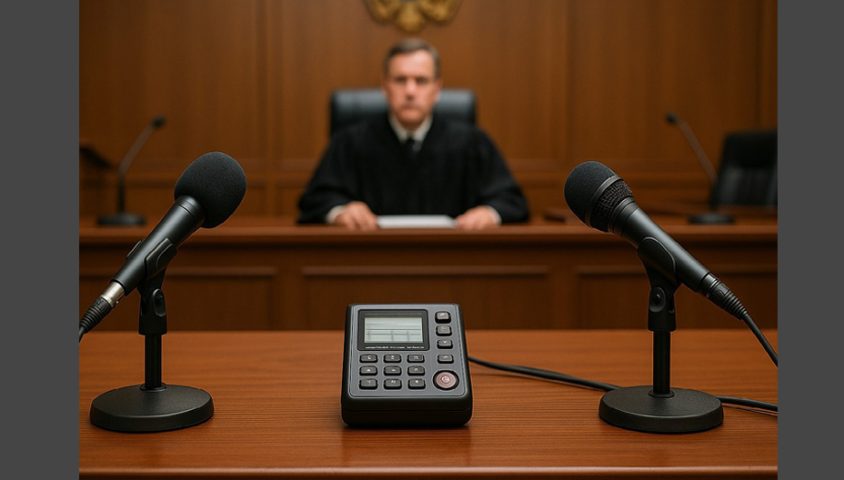
Although the Civil Procedure Code (Article 121) allows audio recording of hearings, in practice it is not used. On the other hand, the Criminal Procedure Code provides that all actions in criminal proceedings should as a rule be audio or audio‑visual recorded (Article 212), yet recording in practice in Montenegro remains a rare exception.
In some regional countries, courts have partially abandoned the dictated‑minutes method — while others, like Montenegro, continue to apply it.
In Albania, audio recording is a legal obligation in civil and criminal proceedings, and a digital audio system has been installed in all courts in the country. In practice, recording is used in the majority of hearings; exceptions occur only when hearings are held in judges’ offices without appropriate equipment or due to technical difficulties.
In Slovenia, audio recording of hearings was introduced in recent years, but it is still not applied uniformly across all courts. Some judges record entire hearings, others only certain phases, while some continue with dictation. Technical challenges — such as very large transcripts and additional burden on court staff — have meant that both models continue to coexist. Because of that, a pilot project “TIPCO”, an automatic speech‑to‑text system, was launched; it has proved to significantly ease the work of judges and clerks.
In Bosnia and Herzegovina, audio recording is standard in criminal proceedings — courts are technically equipped, recording is mandated by law and regularly used in practice for hearings, main trials and other procedural acts, with the audio record becoming part of the case file. By contrast, in civil proceedings audio recording is possible but rarely used; such proceedings continue in small chambers lacking adequate technical conditions.
In Croatia, audio recording of court hearings is provided for by law, but despite years of investments in equipment and software, in practice it is almost never used — courts still rely on dictation. The Minister of Justice (Damir Habijan) announced that this will change, and that audio‑recording will become mandatory from 1 July 2027 in civil, criminal and misdemeanor proceedings — with the introduction of technology in about 1,500 courtrooms across the country.
In Serbia, audio recording of hearings is legally permitted, but in practice almost never used — courts approve recording only in exceptional cases, and dictation remains the norm.
In many countries outside the region, audio recording of hearings is standard practice, including Sweden, Estonia, Austria, Norway, the Netherlands, Portugal, the United Kingdom, Brazil — countries that have fully abandoned the traditional dictation of minutes.
In key strategic documents, such as the 2024–2027 Judicial Reform Strategy and the 2025–2028 Digitization Strategy, there is no explicit mention of introducing audio recording of hearings. The only concrete hint came in a statement during the visit of the President of the Supreme Court of Montenegro to her Slovenian counterpart, where the aforementioned TIPCO system was discussed as an extremely effective tool in court proceedings and a possible option for Montenegrin courts.
According to the latest report on the implementation of the Action Plan for the 2024–2027 Judicial Reform Strategy, the Court of Appeal signed a donation agreement with the U.S. Government — meaning the Court is expected to receive modern audio‑visual conferencing equipment intended for automatic recording of council sessions, trials and other court activities, potentially enabling operation in so‑called “smart courtrooms.”
Given all the above, it is obvious that introducing mandatory audio recording of hearings would be an important step toward modernizing Montenegro’s judiciary. Such a solution would improve the accuracy of minutes, speed up proceedings, increase transparency, and help restore citizens’ trust in the court system.







 English