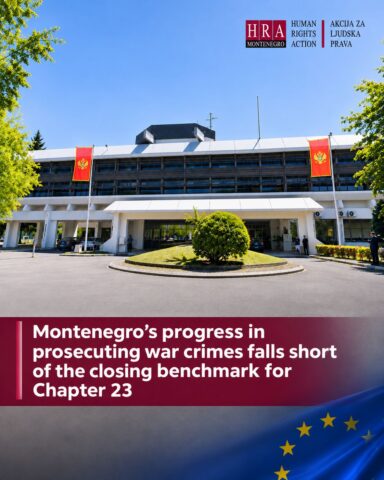
Montenegro’s progress in prosecuting war crimes falls short of the closing benchmark for Chapter 23
Human Rights Action (HRA) warns that Montenegro’s progress in prosecuting war crimes still falls short of the requirements of the closing benchmark for Chapter 23, despite the European Commission’s positive assessment in its report for this year. HRA expects the European Union, through the accession treaty, to continue requiring Montenegro to substantively fulfil the closing benchmarks and to ensure objective monitoring of their implementation. Justice for war crimes victims is one of the most important rule of law tests that Montenegro has yet to pass.
One first-instance judgment and one confirmed indictment in 2025, the reopening of four old cases, and requests to international and regional judicial institutions for evidence and the transfer of cases represent steps forward. However, they remain far from fulfilling the closing benchmark for negotiating Chapter 23, which requires “a credible and sustainable track record of effectively investigating, prosecuting and adjudicating war crimes, including cases involving the highest levels of responsibility, in accordance with international law and standards”.
Based on reports by the Special State Prosecutor’s Office (SDT), it can be concluded that there have been no new investigations or indictments since June 2024, nor any indication that the SDT is examining command responsibility or responsibility for war crimes at the highest level. The review of the four old cases has yet to yield results. The updated agreement with Croatia has not provided any information on what is preventing the Croatian State Attorney’s Office, after nineteen years of preliminary inquiries, from prosecuting those responsible for the abuse and killing of Montenegrin prisoners of war at the Lora military prison in Split in 1992.
The closing benchmark for Chapter 23 also requires “ensuring victims’ access to justice and reparations”. However, victims have yet to receive adequate support or effective access to reparations. The results of the work of the Government’s Commission for Compensation of Montenegrin Citizens Killed or Injured during the Wars of the 1990s remain unknown. The Government’s one-off payments of €100,000 each to 16 families of civilian war victims did not cover all such families and constituted retroactive social assistance payments rather than compensation for harm suffered.
Regarding the search for missing persons, progress in identifying the remains of three members of the Klapuh family in 2025 and 2026 came after many years and repeated appeals by the surviving family member and civil society, following a request from the Missing Persons Institute of Bosnia and Herzegovina.
Even full implementation of the activities under the Action Plan for Chapter 23—such as adopting strategic documents and plans for handling war crimes cases, conducting training, procuring equipment, adapting premises to protect victims and witnesses, and exchanging information and evidence—does not in itself mean that the closing benchmark has been met. These activities must lead to concrete and sustainable results in judicial proceedings and in the exercise of victims’ rights.
With three decades having passed since the wars of the 1990s, time is running out to prosecute war crimes. It is therefore crucial to ensure that Montenegro’s prosecution service and courts intensify their efforts.
It is particularly important to provide reparations to war crimes victims. These are people whose suffering of the gravest kind, unjustly inflicted upon them, has gone unrecognised for three full decades. The death of every victim who has received no reparations represents an irreparable defeat for justice.
The European Union must continue to closely monitor the implementation of all commitments Montenegro has undertaken as part of the accession process and remain steadfast in insisting on their fulfilment.
Prosecutorial proactivity: initiatives exist, but results are lacking
Certain steps have been taken to investigate war crimes. According to a report by the International Residual Mechanism for Criminal Tribunals (IRMCT), the Mechanism is preparing a new investigative dossier at the request of the Special State Prosecutor’s Office (SDT) concerning the possible involvement of a Montenegrin citizen in war crimes. The individual’s identity and details of the work on the dossier are not publicly known. The “Deportation”, “Bukovica”, “Kaluđerski laz” and “Morinj Camp” cases, which were previously not adequately and effectively prosecuted, have also been reopened. Their re-examination is envisaged under the Strategy for the Investigation of War Crimes 2024–2027 and its Action Plan, at HRA’s insistence. Merely reopening these cases is therefore insufficient to justify the positive assessment of prosecutorial “proactivity” in this year’s European Commission report.
Assessing proactivity requires clarification as to whether the SDT, on its own initiative and in a timely manner, examines available information about crimes and potential perpetrators, and what specific steps it takes. As early as 2014, European Commission expert Maurizio Salustro identified avenues for investigating crimes committed on the Dubrovnik front and the possible involvement of Montenegrin citizens in crimes in eastern Bosnia and Herzegovina. Twelve years later, there are still no publicly known concrete results of work along these lines. It was only in 2020, after the IRMCT provided a dossier concerning more than 15 Montenegrin citizens, that the SDT began examining crimes committed in eastern Bosnia, potentially involving so-called “weekend warriors”. However, preliminary inquiries in this case have now been ongoing for six years, also without concrete results.
The first-instance judgment against Slobodan Peković for wartime sexual violence is an important achievement for Montenegro’s judiciary, but it is not an example of a prosecution initiated independently by the SDT. The prosecution was transferred from Bosnia and Herzegovina in 2021, after the authorities there had conducted an investigation and issued an indictment, which Montenegro took over. It should also be borne in mind that this is the only war crimes judgment delivered in the past seven years and that it is not yet final.
Similarly, the case against Zoran Gašović for crimes committed in Hadžići was opened on the basis of a dossier provided to Montenegro by the IRMCT. The SDT did independently gather additional evidence in that case and issued an indictment in June 2024. Since then, no new indictments have been issued or investigations opened. Taking over cases and evidence from abroad does not diminish the significance of the domestic prosecution service’s work. However, these two proceedings, coupled with the absence of new investigations and indictments, are insufficient to substantiate an assessment of continued progress.
Command responsibility remains unprosecuted
The European Commission assesses that a credible and sustainable track record is also being established in cases involving high levels of responsibility, as required by the closing benchmark. However, no war crimes proceedings based on command responsibility have ever been initiated in Montenegro, nor is there any indication that steps are being taken in that direction.
The investigation into former Chief Special Prosecutor Milivoje Katnić for crimes against the civilian population in Cavtat does not alter this fact. According to the publicly available description of the 2024 order to open an investigation, he is suspected of personally subjecting civilians in Cavtat to inhumane treatment, rather than bearing command responsibility. During the war in Croatia, he served as an officer of the Yugoslav People’s Army (JNA) Counterintelligence Service (KOS), holding the rank of lieutenant. This was the second-lowest commissioned officer rank in the JNA, above second lieutenant.
HRA welcomed the reopening of the “Deportation”, “Bukovica”, “Kaluđerski laz” and “Morinj” cases, in which command responsibility is also expected to be examined. The re-examination of these cases should also address the responsibility of those who had a duty to prevent the crimes or take measures to punish those responsible, but failed to do so.
Prosecutors from the Supreme State Prosecutor’s Office analysed the “Morinj” and “Kaluđerski laz” cases and submitted their report to the Special State Prosecutor’s Office (SDT) in the first quarter of this year. However, the findings of these analyses have not been published, nor have any new investigations been opened in these cases. Meanwhile, even the latest semi-annual report on the implementation of the Strategy for the Investigation of War Crimes contains no information on work undertaken in the “Deportation” and “Bukovica” cases. The prosecution service should report on the steps taken in these cases, including those concerning the examination of command responsibility, to the extent that disclosure would not jeopardise the proceedings or victims’ rights. Otherwise, the impression is that these cases were reopened merely as a formality, to ease pressure from the public and the European Union.
The number of cases under preliminary inquiry is not a measure of success
In a chart published in its annual report, the European Commission presented an increase in the number of cases under preliminary inquiry from six in 2024 to 22 in 2025. The Special State Prosecutor’s Office (SDT) was cited as the source. However, the increase shown does not reflect the situation at the end of 2024, when 16 cases, rather than six, were under preliminary inquiry, according to the SDT’s annual report published in January 2025 and a supplementary response provided by the SDT to HRA on 10 March 2025. At that time, there were 19 war crimes cases in total: 16 under preliminary inquiry, one under investigation and two before the High Court in Podgorica—the case against Slobodan Peković at the trial stage and the case against Zoran Gašović at the indictment review stage. Comparing the figures at the end of both years, the increase amounts to six cases, from 16 to 22, rather than 16, as the chart suggests. The European Commission and the SDT should clarify this discrepancy and specify the dates and categories of cases to which the figures refer.
Regional cooperation must work both ways
The European Commission assesses regional cooperation positively and notes that, in November 2025, Montenegro and Croatia signed an annex to the 2006 Agreement on Cooperation in Prosecuting Perpetrators of War Crimes, Crimes against Humanity and Genocide. According to the Commission, this strengthened legal and institutional cooperation between the two countries.
The amendments to the agreement were initiated particularly to improve cooperation in the “Lora 3” case, which the Croatian prosecution service has been examining through preliminary inquiries since 2007. However, no information has been made public about progress in this case or about what is preventing Croatia from proceeding with prosecution on the basis of evidence Montenegro provided as early as 2012 and additional evidence subsequently highlighted by Documenta and HRA.
Furthermore, according to reports by the Special State Prosecutor’s Office (SDT), the Croatian judicial authorities have not responded for more than two years to two requests for mutual legal assistance in cases relating to the Dubrovnik front. These delays cannot be attributed to Montenegro’s prosecution service, but they must be taken into account when assessing regional cooperation. Its effectiveness must be measured by the exchange of evidence, responses to requests for mutual legal assistance and progress in individual cases, rather than solely by the signing of agreements.
Victims’ rights: guidelines are not enough
The European Commission highlights the adoption of guidelines by the Supreme Court of Montenegro on victims’ right to compensation in criminal proceedings. These guidelines are important, but their actual significance depends on their implementation. The closing benchmark explicitly requires that victims be granted access to justice and reparations, which means ensuring that their rights are realised in practice.
The case against Slobodan Peković also illustrates the difficulties victims face. The first-instance court did not rule on the compensation claim submitted by a protected witness who was a victim of wartime sexual violence, instead referring her to civil proceedings. HRA pointed out that compensation should have been decided within the criminal proceedings, so that the victim would not have to initiate separate proceedings, risking disclosure of her identity and retraumatisation. The guidelines were adopted after that judgment and should help change precisely this kind of practice. The proceedings before the Court of Appeal provide a new opportunity to protect the victim’s right to compensation within the criminal proceedings.
The measures taken in the area of reparations likewise do not yet provide a comprehensive and effective compensation system. The Government established a commission to compensate Montenegrin citizens killed or injured during the wars of the 1990s, but the results of its work are not yet publicly known. Families of missing persons, particularly those who went missing in Kosovo and Bosnia and Herzegovina, have still received no compensation, despite being recognised as civilian war victims and having endured three decades of institutional neglect. The one-off payments of €100,000 each to 16 families of civilian war victims did not cover all families and constituted retroactive social assistance payments rather than compensation for harm suffered.
Victim and witness support services have not been established; their establishment is planned only within the next year. In the case against defendant Zoran Gašović, at least two incidents discouraged witnesses from Bosnia and Herzegovina because they had not been provided with basic support during the criminal proceedings.




 English