Amendments to the Criminal Procedure Code could expedite proceedings and improve the protection of human rights, but important issues remain unresolved
Amendments to the Criminal Procedure Code could expedite proceedings and improve the protection of human rights, but important issues remain unresolved
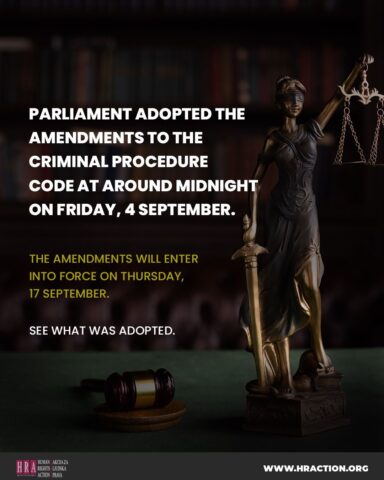
The Parliament of Montenegro adopted the Draft Law on Amendments to the Criminal Procedure Code (CPC) on 4 September, following almost four years of harmonisation with the European Commission, to which the text was first submitted for an opinion in December 2022.
The new amendments to the CPC will enter into force on 17 September. A one-year deadline has been set for establishing specialised victim support services, after which the provisions governing victims’ rights will begin to apply within a further six months.
More than 100 amendments were adopted. They have the potential to improve the efficiency of criminal proceedings significantly and considerably strengthen the protection of victims of criminal offences, defence rights and, in particular, the rights of persons deprived of their liberty. Nevertheless, certain important issues remain unresolved, while progress on others has been only partial.
Expediting criminal proceedings
A new procedure for reviewing indictments should help expedite criminal proceedings. As a rule, indictments will be reviewed on the basis of written submissions from the accused and defence counsel, without a mandatory hearing in every case. Subject to the conditions prescribed by law, the trial may also be held in the absence of an accused person who has previously been questioned, provided that defence counsel is present. The fine imposed on defence counsel whose unjustified failure to appear results in the adjournment of a trial has also been increased and may now amount to as much as €5,000.
A change in the presiding judge or a member of the judicial panel will no longer necessarily require all witnesses and expert witnesses to be questioned again or evidence already presented to be produced anew. The court will be able to read previously given testimony when it finds the evidence need not be presented again. This may prevent a change in the composition of the judicial panel from effectively sending years-long proceedings back to the beginning. Amendments governing appellate proceedings should also contribute to greater efficiency. These include the possibility of holding a hearing in the absence of a duly summoned accused person who fails to appear without justification, as well as a rule under which the same decision of a first-instance court or investigating judge may be quashed only once, thereby preventing cases from being remitted for reconsideration multiple times.
These measures may reduce the number of adjournments, prevent procedural abuse and avoid the unnecessary repetition of evidentiary procedures. However, their contribution to the fairness of trials within a reasonable time will depend on their consistent application and on ensuring that, in every case, the pursuit of efficiency is balanced against the rights of the defence and the right to a fair trial.
Rights of victims of criminal offences
Victims’ rights have also been significantly strengthened, particularly those of victims of human trafficking, offences against sexual freedom, domestic violence, war crimes and terrorism, as well as child victims. They have been guaranteed free access to specialised support services; psychological and professional assistance; protection against intimidation and retaliation; accompaniment by a person of trust; questioning without undue delay; an individual assessment of their needs; and the right to be informed about the progress of proceedings. Access to specialised support services does not depend on a criminal complaint having been filed or proceedings having been initiated and is to be provided before, during and after criminal proceedings.
However, the timeframe for establishing this system is problematic. One year for establishing victim support services, followed by an additional six months before the provisions on victims’ rights begin to apply, is a lengthy period during which rights guaranteed by law will remain without full institutional support. The establishment of these services should have begun earlier, particularly given that it was announced as far back as 2022.
This is especially important for victims and witnesses in war-crimes cases, who often live outside Montenegro and travel from other countries to participate in proceedings. Their arrival, travel, accommodation and stay, as well as the psychological and professional support they require before, during and after testifying, call for timely organisation and must not be left to improvisation. Such comprehensive institutional and logistical support is still lacking, although it is particularly important for people who are forced to relive traumatic experiences through their testimony.
A number of proposals submitted by Human Rights Action (HRA) were also accepted.
Mandatory medical examination of persons deprived of their liberty where ill-treatment is suspected
Of particular importance is the requirement that a person deprived of their liberty undergo a medical examination whenever there are grounds to suspect ill-treatment, with the medical report being included in the case file. This represents an important safeguard against police ill-treatment, given that HRA’s research identified individual cases in which state prosecutors refused requests by injured parties and their lawyers for an immediate medical examination, despite visible injuries on their bodies. Similar problems in practice were also highlighted by the European Committee for the Prevention of Torture and Inhuman or Degrading Treatment or Punishment (CPT) in its reports on its 2013 and 2017 visits to Montenegro.
Requirement to give reasons for withdrawing charges
State prosecutors are now also required to provide the court with reasons for a decision to withdraw charges. This enables the injured party to understand the reasons for the decision and assess whether to pursue available legal remedies or take over the prosecution themselves.
Defence rights
Defence rights have also been strengthened. Before the first questioning, defence counsel will be permitted to read directly the part of the criminal complaint concerning their client, instead of merely being informed of its contents.
Protection of a child’s identity
Where a child appears in recordings or photographs used as evidence, the material will, where necessary, be presented with the child’s face and voice altered.
Maximum duration of detention not extended
It is also important that, despite various public initiatives, the maximum duration of pre-trial detention was not extended from three to five years, thereby preserving the existing level of protection of the right to liberty.
Use of photographs and recordings made without the consent of the accused or suspect
Progress has remained partial, among other areas, with regard to the use of photographs and recordings made without the consent of the accused or suspect and the audiovisual recording of questioning.
Under the previous rules, photographs and recordings could, in principle, be used as evidence only with the consent of the suspect or accused. The amendments permit the use of recordings made without such consent, but only in relation to criminal offences punishable by at least five years’ imprisonment. HRA’s proposal to abolish the consent requirement entirely was therefore accepted only in part. In cases involving less serious offences, the absurd situation may still arise in which a court is unable to use an authentic—and even publicly available—recording made by the media or members of the public. The legislation of Bosnia and Herzegovina, Croatia and Serbia contains no such restriction.
Audiovisual recording
Under the previous rules on audiovisual recording, the questioning of a suspect during the preliminary investigation could be recorded. The law now provides that such questioning “shall, as a rule, be recorded”. However, the CPT has identified the audiovisual recording of all police actions involving members of the public and suspects as one of three key measures for combating torture. HRA therefore proposed the mandatory recording of all procedures conducted by the police, rather than only questioning before a prosecutor.
The adopted provision is narrower: it applies only to the questioning of a suspect during the preliminary investigation, while prior police conduct—during which most instances of ill-treatment have occurred—remains outside the scope of the recording requirement. The law also fails to prescribe either criteria for departing from the recording requirement or an obligation to document such a decision. This leaves the authorities with broad discretion and fails to ensure effective oversight where the risk is greatest.
Issues that remain unresolved
The working group tasked with drafting a new CPC must still address the following highly important issues, which were not included in the adopted amendments:
mandatory psychiatric assessment where torture or ill-treatment is suspected, in accordance with the Istanbul Protocol;
stricter conditions for ordering pre-trial detention, including amendment of the controversial provision under which detention may be ordered for offences punishable by at least ten years’ imprisonment on the basis of the gravity of the offence and the manner in which it was committed;
shorter periods of police and prosecutorial custody;
limits on the duration of secret-surveillance measures;
police entry into another person’s home without a court order in order to enforce a decision on detention, compulsory appearance or deprivation of liberty; and
the right of the defence to receive a reasoned decision when access to the case file is denied.
The adopted amendments represent an important step towards more efficient criminal proceedings and stronger protection for those participating in them. However, the work of bringing the Criminal Procedure Code fully into line with human rights protection standards has not yet been completed.








 English