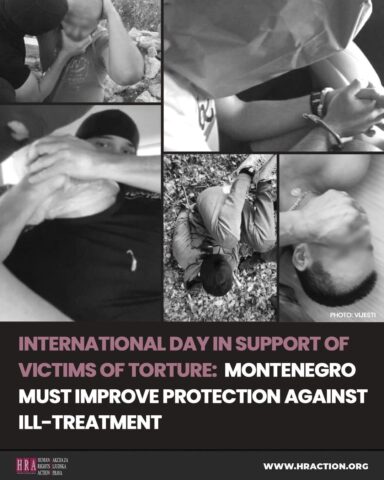
International Day in Support of Victims of Torture: Montenegro Must Improve Protection Against Ill-Treatment
On the occasion of the International Day in Support of Victims of Torture, observed by the United Nations every 26 June since 1997, Human Rights Action (HRA) warns that Montenegro still does not provide protection against torture and other ill-treatment in line with international standards. Investigations into allegations of ill-treatment are often ineffective, creating an impression of impunity, discouraging victims from reporting violence, and increasing the risk of its recurrence. The recommendations of the European Committee for the Prevention of Torture (CPT) have still not been implemented. HRA calls on the competent institutions to take decisive measures this year to improve protection against torture and other forms of ill-treatment, to authorize the automatic publication of CPT reports, and to improve protection of victims’ rights.
Montenegro has still not met the closing benchmark for Chapter 23 in the negotiations on accession to the European Union, which requires the implementation of all recommendations of the European Committee for the Prevention of Torture and Inhuman or Degrading Treatment or Punishment (CPT) and the provision of prompt and appropriate prosecution of ill-treatment.
Although there has been some progress, a gap remains between the normative framework and its implementation in practice.
The European Union has also confirmed that the problem persists. In its 2025 Resolution on Montenegro, the European Parliament called on the Montenegrin authorities to fully implement the CPT recommendations. At the same time, it expressed concern over the increased number of complaints of torture and extortion of statements, the lengthy duration of proceedings, the limited application of key safeguards, such as audio-visual recording of interrogations, as well as lenient sanctions and insufficient accountability of officials for acts of ill-treatment committed.
Further confirmation of these concerns is provided by the CPT’s preliminary findings following its most recent visit to Montenegro in November 2025. The CPT specifically pointed to the situation in the detention system, noting that the treatment of detainees and detention conditions had deteriorated in several respects compared with the situation recorded during the previous visit in 2022. Although it has been announced that certain urgent measures have been taken to improve the situation, we appeal to the Government to approach the implementation of all recommendations of the European Committee systematically, by giving its consent for the automatic publication of the CPT report as soon as it is prepared this summer, and to proceed transparently and urgently with the implementation of recommendations whose fulfillment has been awaited for far too long, especially to ensure:
effective, independent, and timely investigations into all allegations of torture and ill-treatment, with appropriate sanctions for those responsible and the suspension of police officers against whom criminal proceedings are pending;
the introduction of audio-visual recording of all police interrogations and other official interviews with persons deprived of liberty;
that all police officers, including those acting while masked or in civilian clothes, wear visible identification markings;
the improvement of material conditions in police custody and pre-trial detention facilities, including hygiene, ventilation, natural light, sufficient living space, outdoor exercise, and access to basic hygiene products;
the improvement of healthcare for detained and imprisoned persons, including systematic medical examinations and the proper documentation of injuries in accordance with international standards;
the establishment of an effective complaints system and regular contact between detained persons and their families and the outside world.
Data on the work of state prosecution offices show some progress. During the first quarter of 2026, 43 cases were opened concerning allegations of ill-treatment, torture, and extortion of statements. Almost half of these cases were initiated ex officio, that is, on the initiative of prosecutors themselves, which is a positive development and the result of the implementation of the binding instruction issued by the Supreme State Prosecutor in 2024.
However, serious problems persist at the prosecution stage. The greatest challenge lies in cases where evidence was not collected immediately after the incident or after the report of ill-treatment. This is also compounded by the lack of medical experts available at short notice, especially in the north and south of Montenegro. In such situations, prosecutors are forced to refer victims to attending physicians, whose findings are often insufficiently detailed and reliable for the purposes of criminal proceedings. Injuries are not always documented properly, are not consistently photographed, and it also happens that victims’ statements about how the injuries occurred are not entered into medical records.
The consequences of delays in collecting evidence are further compounded by lengthy investigations. At the end of the first quarter of this year, as many as 40 cases from previous years remained unresolved, while heads of state prosecution offices still do not consistently issue mandatory instructions for action in cases of unjustifiably lengthy proceedings. In such circumstances, the risk of losing evidence increases, the establishment of facts becomes more difficult, and the possibility of effectively prosecuting those responsible is weakened.
The lenient sentencing policy is also a cause for concern. In the period from 2022 through June 2026, 29 criminal proceedings for ill-treatment in the broader sense were finally concluded. In 21 cases (72%), convictions were handed down, finding 34 police officers guilty, while six cases ended in acquittals and two due to the statute of limitations for criminal prosecution. The largest number of cases concerned the criminal offence of ill-treatment (22), including in concurrence with other offences; one case concerned extortion of a statement, three grievous bodily harm, one minor bodily harm, and two violent conduct. During this period, there were no final judgments for the criminal offence of torture.
As regards sanctions, suspended sentences continue to dominate — they were imposed on 20 of the 34 convicted officers (around 59%), while effective prison sentences were imposed on eight officers (23.6%) and house arrest sentences on six (17.6%). Suspended sentences, ranging from 30 days to six months, were most often imposed for ill-treatment (18), while in one case each they were imposed for minor and grievous bodily harm.
A positive development was achieved through the Law on the Execution of Prison Sentences, Fines and Security Measures, which has, since 2025, provided that the employment of any UIKS officer who has been finally convicted of the criminal offence of torture or ill-treatment shall be terminated regardless of the type or severity of the sentence imposed. Previously, officers convicted even of serious forms of ill-treatment and sentenced to up to six months’ imprisonment remained in service, contrary to European standards.
It is also necessary to establish and consistently apply additional mechanisms to combat torture and prevent the secondary victimization of victims. This includes continuous training of police officers and state prosecutors on investigative interviewing methods, the use of body cameras during police interventions, the suspension of police officers suspected of torture during the preliminary inquiry and investigation, as well as the accurate keeping of records on the time of deprivation of liberty and all reports of violence.
Of particular concern is the fact that the Law on Compensation for Victims of Criminal Offences is not being applied, as its implementation has been unjustifiably postponed until Montenegro’s accession to the European Union, leaving victims deprived of an important mechanism of support and recognition of the harm they have suffered.








 English