N13.T7 – The Prosecutor’s Office Report under the Shadow of Political Pressure
HRA NEWSLETTER 13 – TOPIC 7
The Parliament of Montenegro did not adopt the 2024 Annual Report of the Prosecutorial Council and the State Prosecutor’s Office. In practice, this fact has little real significance, apart from serving as a symbolic expression of political dissatisfaction. However, during the parliamentary session, there was no reasoned discussion about the content of the report itself. Instead, the debate centered around individual cases that drew the attention of MPs.
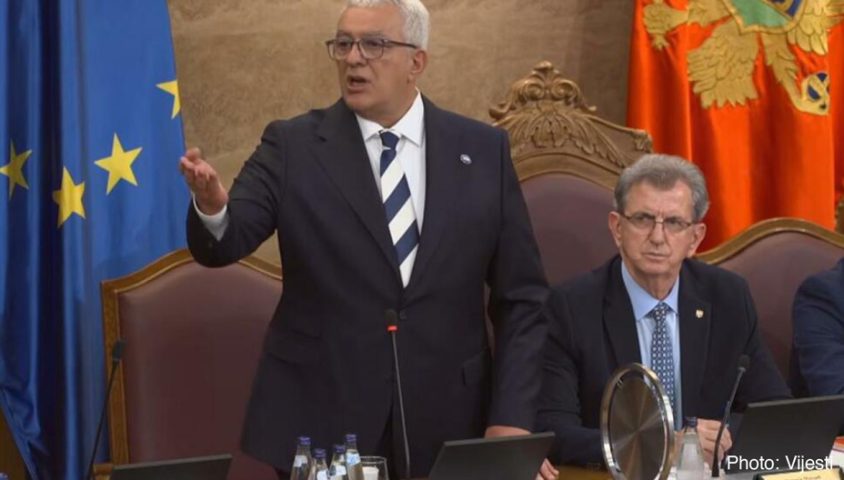
The President of the Parliament, Andrija Mandić, expressed dissatisfaction with the work of the very person he claims to have strongly supported — Supreme State Prosecutor Milorad Marković.
“Stand up and say: I have not met expectations, I am resigning from this position… I expected you to do something about Milo Đukanović, Aco Đukanović, Brano Gvozdenović, Predrag Bošković… You do not dare to say a word about them, yet you deal with cats and who knows what else,” said Mandić, who himself is one of the accused in the “Državni udar” case.
In June, the Special State Prosecutor’s Office filed an appeal before the Court of Appeals of Montenegro against the first-instance judgment in that case, which acquitted all defendants. In early November, proceedings also began before the Basic Court in Podgorica against Mandić’s nephew, Danilo Mandić, who is charged with a serious offense against public safety, causing minor bodily injury, and unlawful possession of weapons and explosive materials.
According to the Police Administration, during the night between April 18 and 19 this year, Danilo Mandić used an official vehicle of the Parliament of Montenegro to block the road and then “fired several shots” at Darko Perović and Aris Turković, “causing injuries to their legs.” Initially, the incident was classified as attempted aggravated murder and unlawful possession and carrying of weapons and explosives, but the State Prosecutor’s Office later dropped the more serious charge.
The President of the Parliament also stated that charges against Prime Minister Spajić remain pending before the prosecution, while cases against members of the Democratic Party of Socialists (DPS) are being dismissed. On the other hand, opposition MPs criticized the prosecution for its (in)action in cases concerning the monument to Pavle Đurišić, political employment, the Vesna Bratić case, and the Meljine–Petijevići road, as well as for allegedly “exerting illegitimate influence on political processes in the country.”
Supreme State Prosecutor Milorad Marković responded that the State Prosecutor’s Office, under his leadership, operates independently and will not act in line with anyone’s political expectations.
Most of the comments made during the debate referred to cases under the jurisdiction of the Special and Higher State Prosecutor’s Offices. Such rhetoric from politicians — especially from the President of the Parliament — constitutes inappropriate pressure on the State Prosecutor’s Office and an attempt to influence specific cases.
It should be recalled that both the European Commission and the UN Special Rapporteur have clearly stated that politicians should refrain from public comments that may amount to pressure on holders of judicial office, including judges and state prosecutors.
However, the parliamentary discussion lacked any substantive analysis of the report itself — including the handling of disciplinary and ethical violations, complaints, evaluations, appointments and promotions of state prosecutors, and the significant issue of case backlogs.
Unfortunately, what could have been an opportunity to discuss performance and challenges faced during the previous year turned into a political debate filled with accusations and personal messages. A valuable chance was missed for an open and well-argued dialogue that could have contributed to greater transparency, a better understanding of the role of the State Prosecutor’s Office, and stronger support for its independent and efficient functioning.



 English