KNEŽEVIĆ AND VRANEŠ ADMIT TO GLORIFYING MLADIĆ – THE PROSECUTION AND PARLIAMENT MUST NOW ACT
Non-governmental organisations and civic activists strongly condemn the statements made by MP and President of the Democratic People’s Party (DNP) Milan Knežević and President of the Municipality of Pljevlja and official of New Serb Democracy (NSD), Dario Vraneš, during police questioning on 8 October concerning their earlier public statements about Ratko Mladić, a war criminal convicted by a final judgment. We call on the State Prosecutor’s Office to examine, without delay, whether grounds for criminal liability exist and to take the measures prescribed by law, and on the Parliament of Montenegro to initiate proceedings to determine MP Knežević’s ethical responsibility.
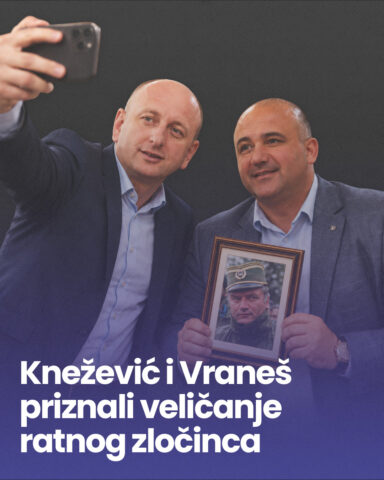
Rather than distancing themselves from the glorification of a war criminal, which had prompted their questioning, Knežević and Vraneš repeated and further intensified their earlier statements before the police. Knežević stated that he fully stood by everything he had said about Mladić in the Parliament of Montenegro and on social media, that Mladić was, in his view, a “war hero, not a criminal”, and that he was prepared to serve a prison sentence for his beliefs. Vraneš described Mladić as an “immortal Serbian hero”, stating that he was honoured to have published a death notice and attended the funeral. Both subsequently published the records of their police questioning on social media, turning the actions of state authorities into an opportunity for political self-promotion and an overt display of disrespect for Montenegro’s legal order.
We believe that their statements provide grounds for the State Prosecutor’s Office to examine whether the elements of a criminal offence under Article 370 of the Criminal Code of Montenegro are present, including the statutory conditions under which the public approval, denial or minimisation of international crimes entails criminal liability. Knežević additionally stated that he would not invoke parliamentary immunity, thereby indicating that he was not seeking protection from possible proceedings. We therefore expect a timely, independent and impartial decision by the competent State Prosecutor’s Office.
Non-governmental organisations and civic activists recall that Ratko Mladić was sentenced to life imprisonment by an international court, in a final judgment, for the Srebrenica genocide, crimes against humanity and violations of the laws or customs of war. Proclaiming a person convicted of genocide a “hero” and a “saviour of the people” is not a harmless political provocation, but an act that deeply offends the dignity of victims and their families, relativises judicially established crimes and contributes to their normalisation in society. Freedom of expression cannot serve as a pretext for inciting hatred with impunity or for conduct that indisputably meets the statutory elements of a criminal offence.
Knežević’s statements also raise the question of his responsibility under the Code of Ethics for MPs. The Code obliges MPs to respect human rights, equality and the dignity of the Parliament of Montenegro. The glorification of a war criminal convicted by a final judgment, first from the parliamentary rostrum and subsequently before the police, is incompatible with the responsibilities inherent in the office of an MP. We call on the Committee on Human Rights and Freedoms to initiate proceedings within the scope of its powers, determine Knežević’s ethical responsibility and impose an appropriate measure. Parliament must not remain silent in the face of conduct that undermines the values Parliament itself affirmed by adopting the Resolution on the Genocide in Srebrenica in 2021, which condemns the Srebrenica genocide in the strongest terms and prohibits the public denial of its occurrence or the minimisation of the genocide.
Responsibility for such public statements cannot stop at the national level. The Municipal Assembly of Pljevlja owes citizens an answer as to whether the glorification of a convicted war criminal is compatible with the duties, responsibilities and ethical standards of the President of the Municipality. The office of President of the Municipality must not serve as a platform for relativising war crimes, nor may public authority be used to glorify them.
We also reject attempts to portray the actions of the competent authorities as “persecution of the Serbian people”. Criminal responsibility is individual, just as Mladić’s was. No one has the right to associate an entire people with the crimes of an individual, yet that is precisely what those who proclaim a convicted war criminal a hero of an entire people are doing. Insisting on the application of the law is not an attack on any people, but a demand that all citizens and public officials be treated equally before the law.
Non-governmental organisations and civic activists warned as early as late September that the unpunished glorification of Ratko Mladić threatened to become an accepted practice in Montenegro’s public sphere. When public officials continue to convey the same messages even after being summoned for police questioning, it is clear how little they are concerned about the prospect of being held accountable by the relevant institutions.
This is therefore no longer merely a question of two politicians’ attitudes towards war crimes, but also a question of the credibility of Montenegro’s institutions. Every day of unjustified institutional silence further discourages victims and their families, while sending the public a message that political power can serve as a shield against accountability.
The State Prosecutor’s Office and Parliament now have an opportunity to demonstrate that the law, final court judgments and the dignity of victims carry greater weight than political office and party interests.




 English